
How to Organize a Closet Over 40 (For What You Actually Wear)


Last spring I stood in my closet and counted. Forty-one tops. Then I counted the ones I had worn since March. Six. That one number taught me more about how to organize a closet over 40 than any storage bin ever did.
The other thirty-five tops weren’t bad clothes. They belonged to a woman I used to be. She had a long commute, a different bra size, and no silver coming in at the temples.
That’s the real problem with most closets after 40. They aren’t messy. They’re set up for the wrong life.
This guide sets your closet up around the clothes you reach for today. You’ll start with real wear data instead of guesses. You’ll sort into four piles instead of two, so pieces that fit on some days have a home that isn’t the donation bag.
Then you’ll arrange the space for the body and the eyes you have now. That means daily pieces at arm height, brighter corners, and fewer things to bend down for.
Plan on four to five hours. You can split it into a Saturday sort and a Sunday setup. None of it is hard on your body. The hard part is deciding, and each step below makes those decisions smaller.
How Long This Really Takes
Active Time
About 3 hours
The rest is a donation drop and a tailor run
Difficulty
Gentle
Light on your body, tough on your decisions
Grab These Before You Open the Closet Door
Having everything in one spot means you won’t stop halfway to go hunting.
- 4 laundry baskets or boxes, one for each sorting pile
- Painter’s tape and a thick marker for labels you can read without glasses
- 20–30 matching slim velvet hangers, which grip and save space
- A full-length mirror propped near the closet
- Your everyday bra, the one you actually wear
- The 2 pairs of shoes you wear most
- Donation bags (large trash bags work too)
- 1 tote bag for the tailor pile
- 2–4 battery LED tap or motion lights
- Your phone for photos and a timer
- A damp cloth to wipe shelves while they’re empty
- Optional: shelf dividers and a shoe rack that sits at waist height
The Whole Weekend on One Screen
- Move the last 14 days of outfits to the left end of the rod
- Clear 3 feet of closet at a time
- Sort into Wear, Fix, Flex and Release
- Try on the “not sure” pile with your real bra and shoes
- Set up a labeled flex zone
- Hang daily pieces between shoulder and hip height
- Pair tops with the bottoms you wear them with
- Fold sweaters in stacks of three
- Add lights to the dark back corners
- Turn hangers backward and check in 90 days
Pull everything you wore in the last 14 days onto the left end of the rod

You don’t need a tracking app for this. Your phone already has the data. Scroll back two weeks in your photo roll, then check the laundry basket. Those two places show what you really put on, not what you meant to wear.
Move each of those pieces to the far left of your rod. Include the boring ones too: the black leggings, the gray cardigan, the jeans with the faded knee. If something is in the wash, write it on a strip of painter’s tape and stick the tape to the rod where it would hang.
Expect around 15 to 25 pieces. That small group is your real wardrobe right now. You’ll measure every decision for the rest of the weekend against it. When you hold up a blouse later and can’t decide, ask yourself one thing: would this ever hang with the left end?
If the last two weeks were unusual, like a vacation or a sick week, go back 30 days instead.
Empty one 3-foot section at a time, never the whole closet
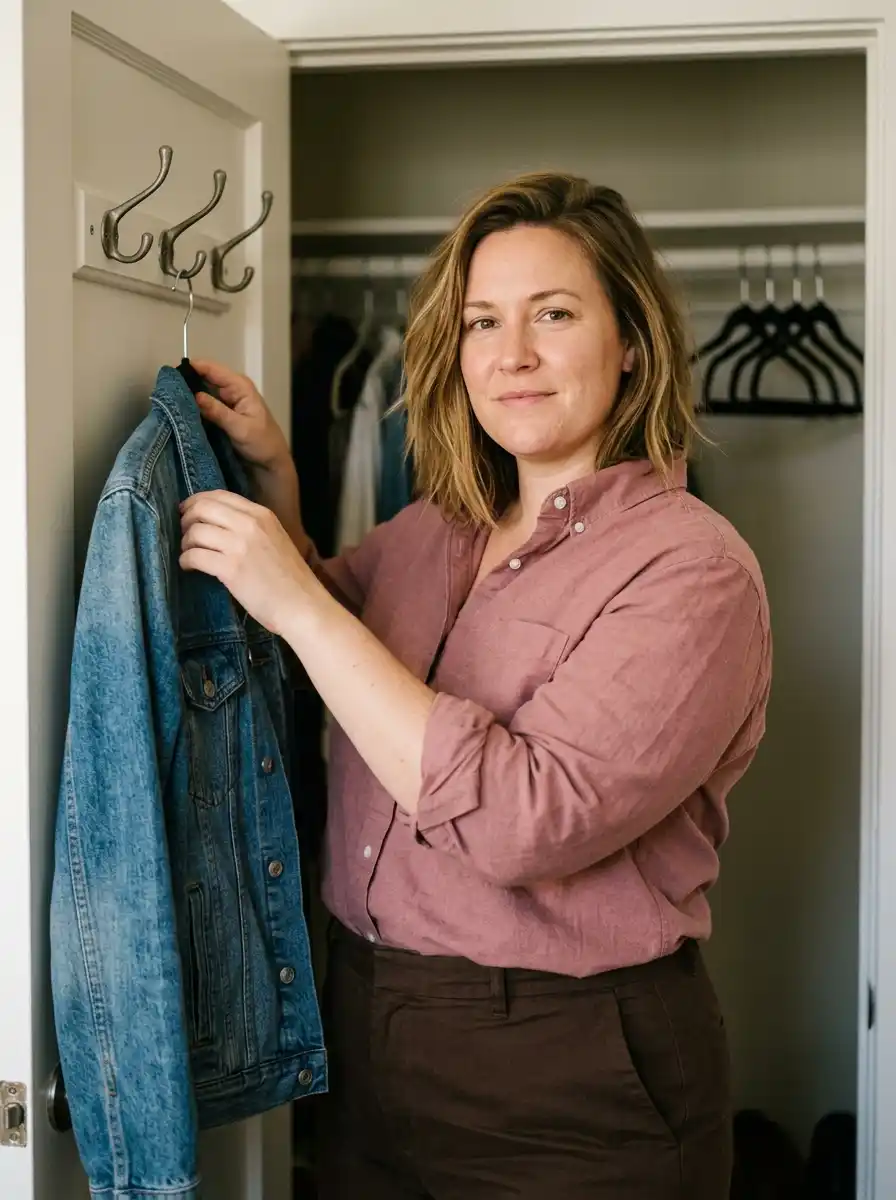
Three feet of rod holds about 25 to 30 hangers. That’s enough to sort in 30 to 40 minutes, before your back or your patience gives out. Pulling the whole closet onto the bed feels productive for about an hour. After that, you’re stuck with a mountain you can’t sleep under until it’s gone.
Mark off the section with two strips of painter’s tape on the rod. Lay those pieces on the bed. While the rod and shelf above are bare, wipe them with a damp cloth.
Start with the section right next to your left-end group. Those pieces are closest to what you already wear, so your first decisions come faster.
Sort each piece into Wear, Fix, Flex or Release

Two piles, keep and toss, is where most closet clean-outs fall apart. Too many pieces don’t belong in either one, so they slide back onto the rod. Four piles give every piece a clear next move.
Label four baskets with painter’s tape:
- Wear: fits today, feels good, and you’d put it on this week.
- Fix: you love it, but it needs a hem, a button or a new zipper.
- Flex: fits on some days and not others. Step 5 gives these their own home.
- Release: you haven’t worn it in 12 months and wouldn’t miss it.
Give each piece about 10 seconds. If you can’t decide in that time, set it on a chair. That chair becomes your try-on pile for the next step.
When you finish, put the Fix basket by your front door. Write a date 30 days from today on its tape. Anything that hasn’t gone to the tailor by that date moves to Release.
Don’t Let the Price Tag Do the Sorting
What a piece cost has nothing to do with which pile it belongs in. A $200 blazer you never wear takes up the same rod space as a $20 tee you love. If letting it go stings, put it in Release and resell it online. That gets some of the money back.
Try on the “not sure” pile in your everyday bra and shoes

A blouse can look fine on the hanger and still fail the moment you sit down in it. That’s why this pile gets a real try-on, not a guess.
Put on the bra you wear most days and a pair of shoes from your left-end group. Bust shape and posture often change after 40. An old fitting-room bra can hide gaps that your daily one will show.
Stand at the mirror near a window, then sit down for 30 seconds.
If buttons gap across your chest or the waistband digs in when you sit, ask whether a tailor could fix it. If yes, it goes to Fix. If no, it goes to Release.
If it fits but your skin looks gray or tired, hold it up to your face next to a left-end piece. Colors that worked with darker hair can wash you out now. If the left-end piece looks better, Release this one.
If it fits and looks good but you never reach for it, it’s probably missing a partner piece. Put it in Wear, and add that missing piece to a list on your phone.
Give size-swing pieces their own labeled flex zone
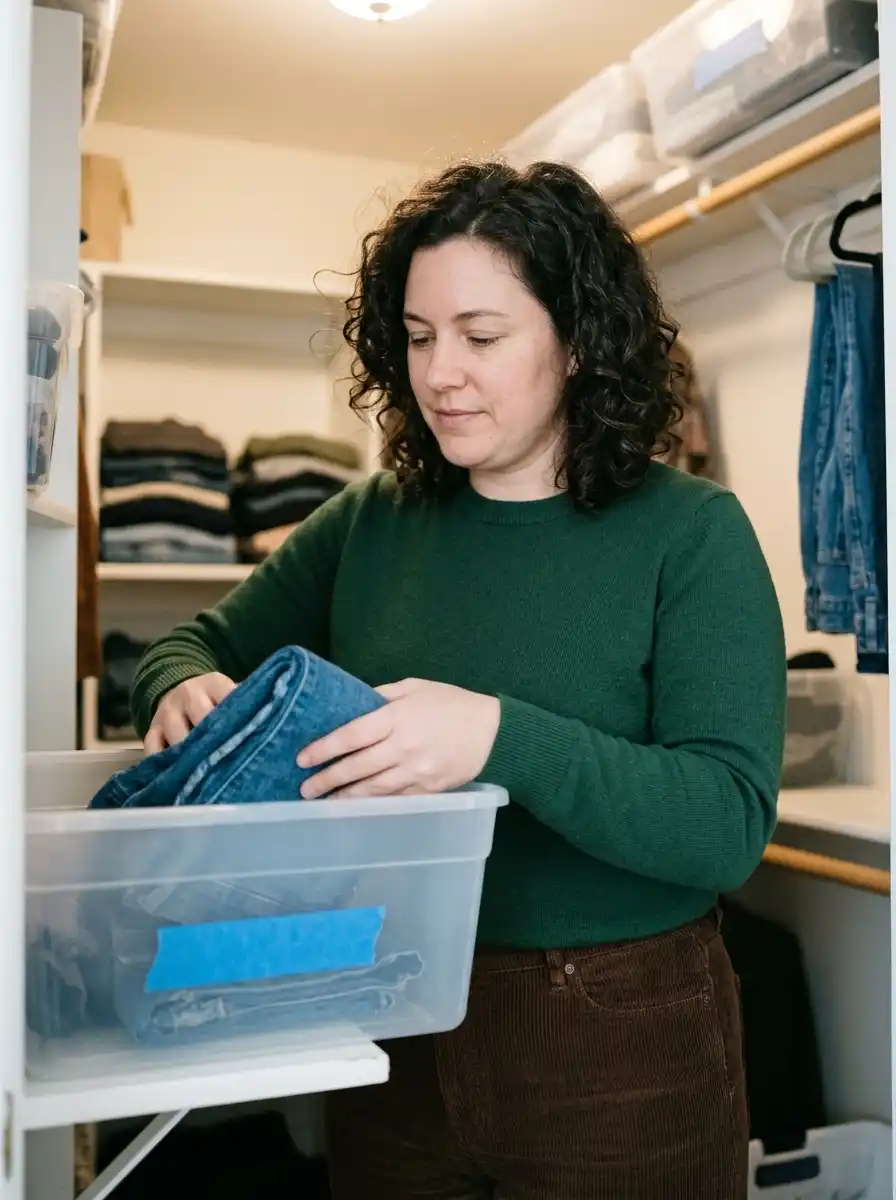
If your jeans fit on Monday and pinch by Thursday, you’re not imagining it. Weight and bloating can shift week to week in your 40s and 50s, often along with hormone changes. A closet that holds only one size will make you feel bad on half of those days.
Pick one home for these pieces: the far right end of the rod, or one clear bin on a shelf. Cap it at 10 to 12 items. Without a limit, the flex zone slowly turns into a second closet.
A piece only counts as Flex if it has fit you at least once in the last 6 months. Jeans that haven’t fit in years are not flex pieces. They belong in Release.
Write FLEX on painter’s tape in letters at least 1 inch tall, so you can read the label without glasses.
Organize your closet over 40 around the shoulder-to-hip reach zone

About 24 inches of height, from roughly your shoulders to your hips, is the most useful storage space you have. You can see it, reach it, and grab from it without bending, stretching or climbing a step stool. Your Wear pile goes here and nowhere else.
Hang your Wear pieces on the part of the rod closest to the door, where the light is best. If your rod sits above shoulder height, add a hanging double rod (about $15–$25). It hooks onto the main rod and adds a lower bar, so tops hang up high and pants hang at hip level.
Get your shoes off the floor if you can. A small rack on a waist-height shelf saves you from kneeling every morning.
Keep the high shelf for things you touch a few times a year, like off-season pieces and special-occasion bags. The floor holds only heavy items: boots, luggage and the donation bag you’re filling.
Give Your Top Five the Front Row
Open the closet door and notice where your hand naturally lands. Hang the 5 pieces you wear most in that exact spot. On rushed mornings, your best outfit will be the first thing you grab.
Pair each top with the bottoms you actually wear it with

At 7 a.m., a closet sorted by color makes you build every outfit from scratch. It looks tidy in photos, but it hands you a new puzzle every morning. Hanging by outfit means the decision is already made the night before, by you.
Inside your reach zone, work in small groups:
- Hang one bottom you wear often.
- Right beside it, hang the 2 or 3 tops you really wear with it.
- At the end of the group, hang the cardigan, blazer or jacket that finishes the outfit.
Some tops go with almost everything, like a white tee or a navy sweater. Hang those in the middle of the rod so every group can borrow them.
Take a quick photo of each group before you close the door. Save the photos in a phone album with a name like “Outfits That Work.” On mornings when nothing feels right, scroll the album instead of the rod.
Fold sweaters in stacks of three so the shoulders never stretch

Gravity pulls a hanging sweater down a little more every week. After a month or two, the shoulders stretch into pointed bumps that won’t steam out.
Lay each sweater face down on the bed. Fold both sleeves across the back. Fold the sides in until the sweater is about the width of a magazine. Fold it in half from the bottom.
Keep each stack to 3 sweaters, or about 10 inches high. Taller stacks topple when you pull one from the middle, and you’ll stop refolding them. On a wide shelf, shelf dividers keep the stacks from leaning into each other.
Thin knits can still hang. Drape them over the hanger’s bar instead of putting them on the shoulders.
Light the back corners so navy and black stop looking the same
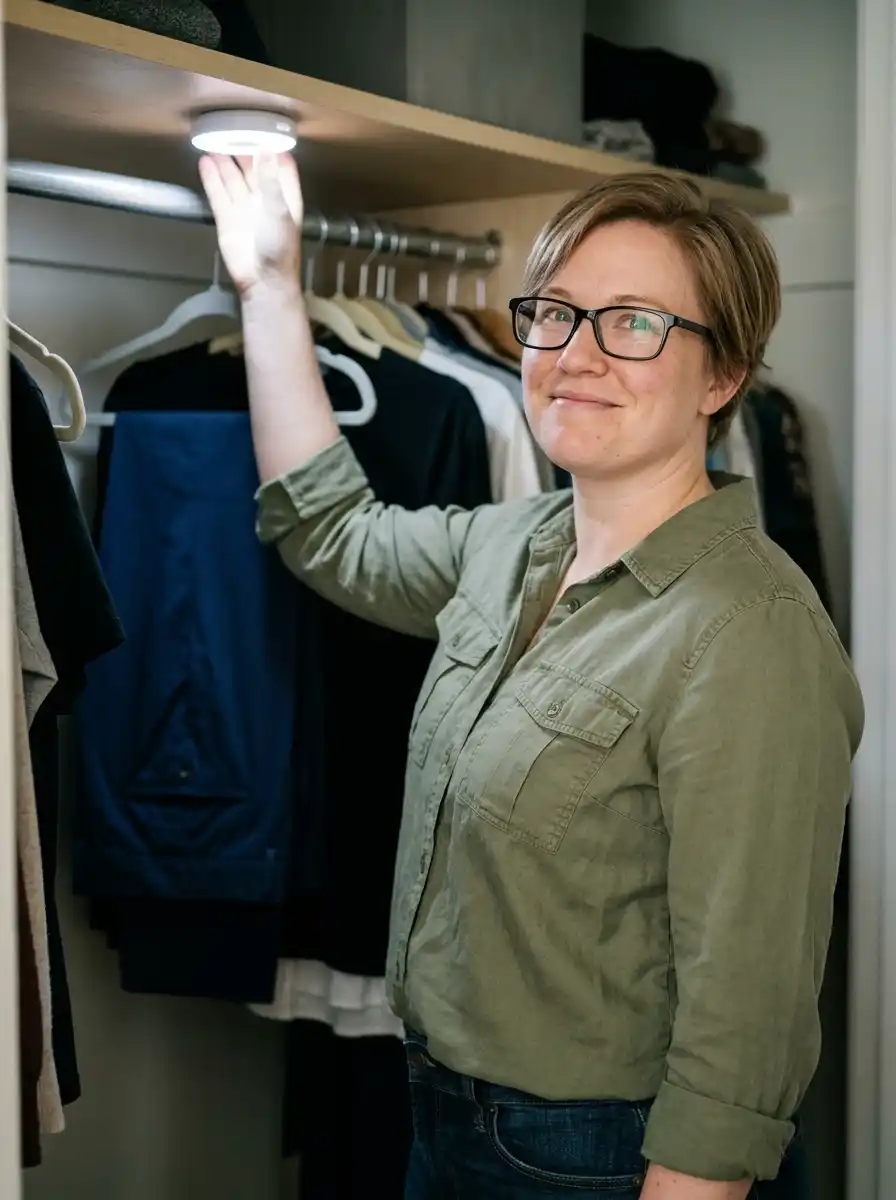
I once wore navy pants with a black top to lunch and didn’t notice until I caught my reflection in the restaurant window. My closet had a single bulb near the door, and the back of the rod sat in shadow.
Most of us need more light to tell dark colors apart as we get older. Yet the closet is often the darkest spot we get dressed in.
Stick 2 to 4 battery LED lights under the shelf above your rod, about 18 inches apart. Motion-sensor lights turn on when the door opens, so you don’t have to find a switch. Rechargeable USB lights save you from buying batteries.
Check the box for the light color. Look for 4000K to 5000K, often sold as “daylight” or “neutral white.” Warm light around 2700K makes navy, charcoal and black blur together.
While you’re up there, look at your bin labels. If you have to squint at one, rewrite it in bigger letters.
Keep Hot Bulbs Away From Your Clothes
Skip halogen and old-style incandescent bulbs inside the closet. They get hot, and fabric often hangs only inches away. LED lights stay cool to the touch, so they’re the safe choice for small spaces packed with clothes.
Turn every hanger backward and check it again in 90 days
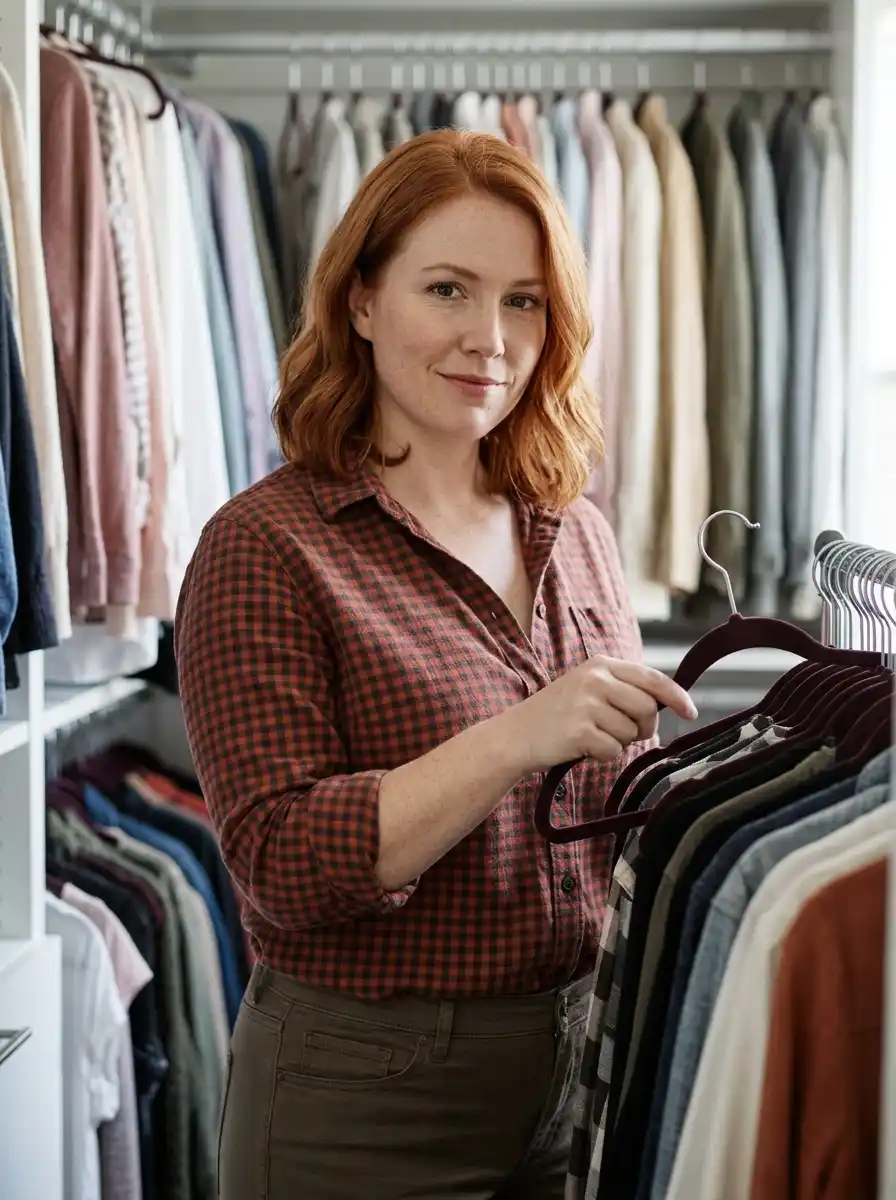
If a hanger is still facing backward three months from now, that piece has made its own decision.
Turn every hanger in your Wear and Flex zones so the hook opens toward you. That’s the opposite of how most people hang clothes. After you wear something, hang it back the normal way. You don’t need a notebook or an app, because the hangers keep the count.
Set a phone reminder for 90 days from today. When it goes off, take 20 minutes to:
- Pull out every piece still hanging backward and try it on.
- Recount the flex zone and trim it back to 12 items.
- Check the date on the Fix basket.
Seasonal pieces get a pass. A wool coat that hung backward all summer gets judged next winter, not now.
Most people find a few surprises each round. Every hanger you free up makes room for something you’ll wear.
When Your Closet Starts Creeping Back
A few weeks in, old habits often show up again. Here’s how to catch them early.
| What’s Going Wrong | What Fixes It |
|---|---|
| Clothes pile up on a chair instead of going back on the rod | Those are usually pieces you wore once that aren’t dirty yet. Add 2–3 hooks inside the closet door for jeans, blazers and cardigans waiting for another wear. |
| The flex zone keeps growing past 12 pieces | Use one-in, one-out. Every time a piece moves into the flex zone, pick one to move out the same day. |
| The Release bags are still in your trunk a month later | Book a donation pickup before you start sorting, so the bags have a deadline. If you drop them off yourself, add the stop to your next grocery run. |
| The Fix basket hasn’t moved from the front door | Choose a tailor on a route you already drive. Take 2 pieces at a time instead of the whole basket, so the trip feels small enough to do. |
| The Wear section feels packed again after a shopping trip | Keep 5 empty hangers at the end of the rod. When they’re gone, the closet is full, and something has to go before anything new comes in. |
| You’re still wearing the same 6 tops | Open your “Outfits That Work” album and wear one new group each week. Check your missing-partner list too, since one camisole or belt can bring three tops back into use. |
Conclusion
Your closet now opens on the clothes you really wear. Your flex pieces have a home, and you can finally see what you’re grabbing.
Here’s your challenge for this week: wear one outfit group you haven’t touched in a month, straight from your new reach zone.
When your 90-day reminder goes off, the backward hangers will show you exactly what still earns its spot. That check is what makes this way to organize a closet over 40 keep working long after the weekend you cleaned it.
Pin this to your closet or home board so the checklist is waiting when that reminder pops up.
Print it · Screenshot it · Tape it up
The Tape-It-Inside-the-Door Version
Your Kit
- 4 baskets: Wear, Fix, Flex, Release
- Painter’s tape + thick marker
- 20–30 slim velvet hangers
- Full-length mirror
- Everyday bra + 2 favorite shoes
- Donation bags + 1 tailor tote
- 2–4 LED lights (4000K–5000K)
- Phone for photos + reminder
Numbers to Remember
- 3 ft of rod per session
- 10 sec per sorting decision
- 12 max in the flex zone
- 3 sweaters per stack
- 30 days for the Fix basket
- 90 days until hanger check
The 10 Moves
- Move the last 14 days of outfits to the left
- Clear 3 feet at a time
- Sort into Wear, Fix, Flex, Release
- Try on “not sure” pieces in your real bra
- Label one flex zone
- Hang Wear pieces shoulder to hip
- Group tops with their bottoms
- Fold sweaters, 3 per stack
- Light the dark corners
- Turn hangers backward, check in 90 days
FAQs
Questions Readers Ask Halfway Through the Purge
What about the clothes I’m saving for when I lose weight?
If a piece hasn’t fit in 6 months, it doesn’t belong in your closet. If letting go feels like too much right now, pack those pieces into one bin, write today’s date on it, and store it outside the closet. Check it again in 6 months.
My closet is tiny. Where does the flex zone go?
Try a shallow under-bed bin or a hanging organizer over the back of the door. Both keep flex pieces close without crowding your reach zone.
What do I do with my mom’s cardigan, or the dress I wore to my daughter’s wedding?
Sentimental pieces can stay, but they don’t need prime rod space. Give them a memory box on the high shelf, or hang one favorite at the far end of the rod.
I work from home now, or I’m retired. Do I keep my office clothes?
Keep 1–2 polished outfits for interviews, funerals and formal meetings, and release the rest. Suits that sit for years often go out of date before you need them again.
I share the closet with my husband. How do we split the reach zone?
Split the rod by side, and give each person their own shoulder-to-hip band. Whoever is shorter can take the lower bar of a double rod, which puts it right at her reach.
Do all my hangers really need to match?
No, but slim velvet hangers take up about half the space of plastic or wooden ones, and clothes don’t slide off. Swap them in a few at a time as you release clothes.