
How to Dress After Weight Loss Over 40 When Nothing in Your Closet Fits


Last spring I was crossing a grocery store parking lot when my favorite jeans started sliding down my hips. One hand was on the cart. The other was a fist around my waistband. I had lost twenty-two pounds, and the jeans I had loved for six years were now a problem.
That moment is why I wrote this guide on how to dress after weight loss over 40. Losing the weight was the hard part. Getting dressed afterward should feel like the reward, but for a lot of us it feels confusing.
The size on your old labels is wrong. Your bra rides up. Your arms or tummy may have loose skin you did not expect. And you can’t tell whether to buy new clothes now or wait.
By the end of this guide, you will know your real new size and which old pieces are worth tailoring. You’ll also know what to buy first, and how to dress your new shape without hiding under baggy tops.
The method works because it goes in a set order. First you check that your weight has settled.
Then you measure and fix your bra, and only after that do you sort, tailor and shop. That order keeps you from spending money on a size you might shrink out of next month.
The hands-on work takes one weekend. A tailor will need another 1 to 2 weeks.
Grab These Before You Open Your Closet
Most of this is already somewhere in your house.
- ✓Soft measuring tape (60-inch sewing tape)
- ✓Bathroom scale for weekly weigh-ins
- ✓Full-length mirror
- ✓20 safety pins to pin loose fabric during try-ons
- ✓3 laundry baskets or bags labeled Keep, Tailor, Let Go
- ✓Sticky notes or masking tape to mark tailor notes
- ✓Your phone with the camera timer turned on
- ✓A notes app or notebook for your numbers
- ✓A thin belt or stretch belt
- ✓A fitted tank and leggings to wear under try-ons
Your 9-Step Closet Reset
- Wait for your weight to hold steady for 6 weeks
- Measure bust, waist, hips and inseam
- Get a bra fitting
- Sort clothes into Keep, Tailor and Let Go
- Tailor only pieces 1–2 sizes too big
- Buy 5 stretchy bridge pieces
- Trade baggy tops for structured fabrics
- Belt your new waistline
- Check your fit in a photo, not the mirror
Hold off on full-price buys until your scale stays within 3 pounds for 6 weeks

Your body keeps settling for a while after the scale drops. Clothes you buy in month one can hang loose by month three, and that money is gone.
Weigh yourself once a week, on the same day, at the same time, before breakfast. Write the number down. When six weekly numbers sit within 3 pounds of each other, your size has settled.
If you are still losing: buy only what you need to get through the week, and buy it secondhand or on sale. Stretchy knits and pull-on pants work best here, because they give a little as you shrink.
If your weight has held for 6 weeks: you’re ready for tailoring and full-price basics in Steps 5 and 6.
Either way, do Steps 2 through 4 now. Measuring and sorting cost nothing, and they show you what you already have to work with.
Shopping While the Scale Still Moves
Resale apps like ThredUp and Poshmark, plus local consignment shops, are the best place for in-between sizes. You can often find a pair of name-brand jeans for under $20. When you size down again, sell them back.
Record your new bust, waist, hip and inseam numbers with a soft tape

Four numbers will help you more than any size label. Every brand cuts sizes differently, and the “medium” you used to wear means nothing now.
Stand in your underwear in front of the mirror. Relax your stomach and measure:
- Bust: around the fullest part, with the tape level across your back
- Waist: the narrowest point, usually about 1 inch above your belly button
- Hips: around the widest part of your bottom
- Inseam: from the crotch seam to the hem of your best-fitting pants
The tape should lie flat and snug without pressing into your skin.
No soft tape? Wrap a piece of string around yourself, mark where it meets with a pen, then lay it flat on a yardstick.
Save all four numbers in your phone. Before you finish, try on your shoes and rings too, because feet and fingers can shrink after big weight loss.
Book a professional bra fitting before you try on a single top

If your band rides up your back or your straps keep slipping, your bra size has changed. That one problem changes how every top you own hangs.
Most of a bra’s lift comes from the band, not the straps. When the band is loose, your bust sits lower, and tops pull and sag in the wrong places. You may blame the shirt when the bra is at fault.
Lingerie departments and bra boutiques often do fittings for free. A fitting takes about 15 minutes. Ask the fitter to check both band and cup. When the band drops, the cup letter often goes up to hold the same volume, so a 38C may now be a 36D.
No fitter nearby? Check at home. A new bra should feel snug on the loosest hook, with room for only two fingers under the band at your back. The center piece between the cups should lie flat against your chest.
Wear your new bra for every try-on from here on.
Before You Buy Five New Bras
If your weight is still dropping, buy one or two bras now, not a full drawer. Moving an old bra to its tightest hook is a stopgap at best, because the cups will still gape and wrinkle under fitted tops.
Sort jeans, blazers and dresses into keep, tailor and let-go piles using the pinch test

Set a timer for 2 hours and start with pants. You wear them most, and they sag first. Move on to blazers, then dresses. Do every try-on over your tank and leggings, wearing your new bra.
Put each piece on and pinch the extra fabric at one side seam. Hold it with a safety pin, then check how deep the fold is.
Keep: the fold is under 1 inch. A belt or a front tuck will handle it.
Tailor: the fold is 1 to 2 inches, which is about 1 to 2 sizes too big. A tailor can fix that. Stick a note on the piece saying what feels loose.
Let Go: the fold is deeper than 2 inches, or the shoulder seam hangs more than 1 inch past your shoulder bone. Shoulders are the hardest part of a jacket to change, so even a blazer you love belongs in this pile.
Bag the Let Go pile the same day. Sell or donate it within 30 days, because a rack of clothes that don’t fit slows you down every morning.
Send only pieces 1–2 sizes too big to a tailor
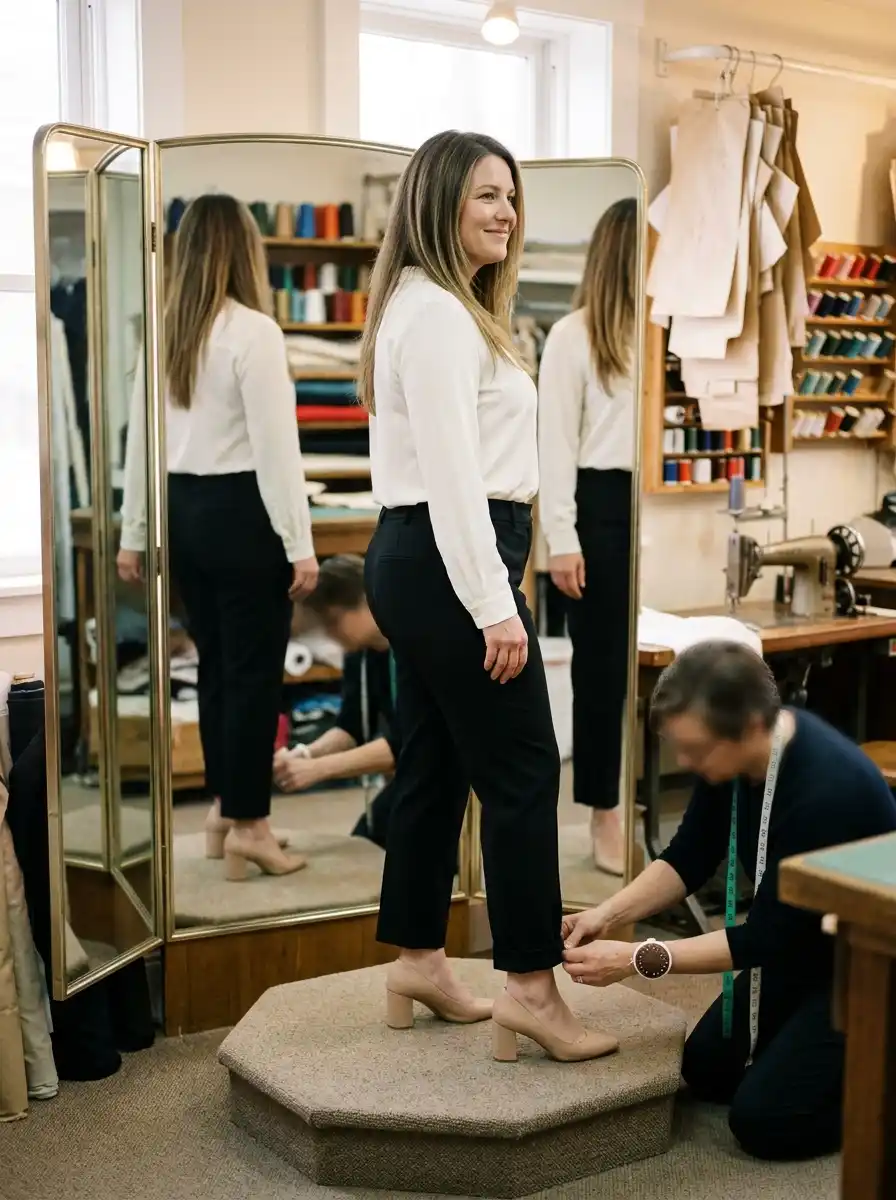
$20 to $40 is a common price to take in a pair of pants at the waist. A blazer often costs $50 or more. Those prices add up fast, so be picky.
Before you hand anything over, ask one question about each piece. Would the alteration cost more than half of what a new one would? If yes, skip it.
Good jobs to pay for are taking in side seams, waistbands and dress bodices, plus hemming. Avoid jeans that are more than two sizes big. The back pockets will sit too far apart and the rise will still sag, even after the waist is fixed.
Wear your new bra to the fitting, and bring the shoes you’ll wear with the piece so hems land in the right place. Expect 1 to 2 weeks before it’s ready.
Ask This at the Tailor’s Counter
Ask the tailor to leave the extra seam fabric inside rather than cutting it off. If your body shifts again, the piece can be let back out instead of being replaced.
Fill the gaps with 5 stretch-friendly bridge pieces under $150
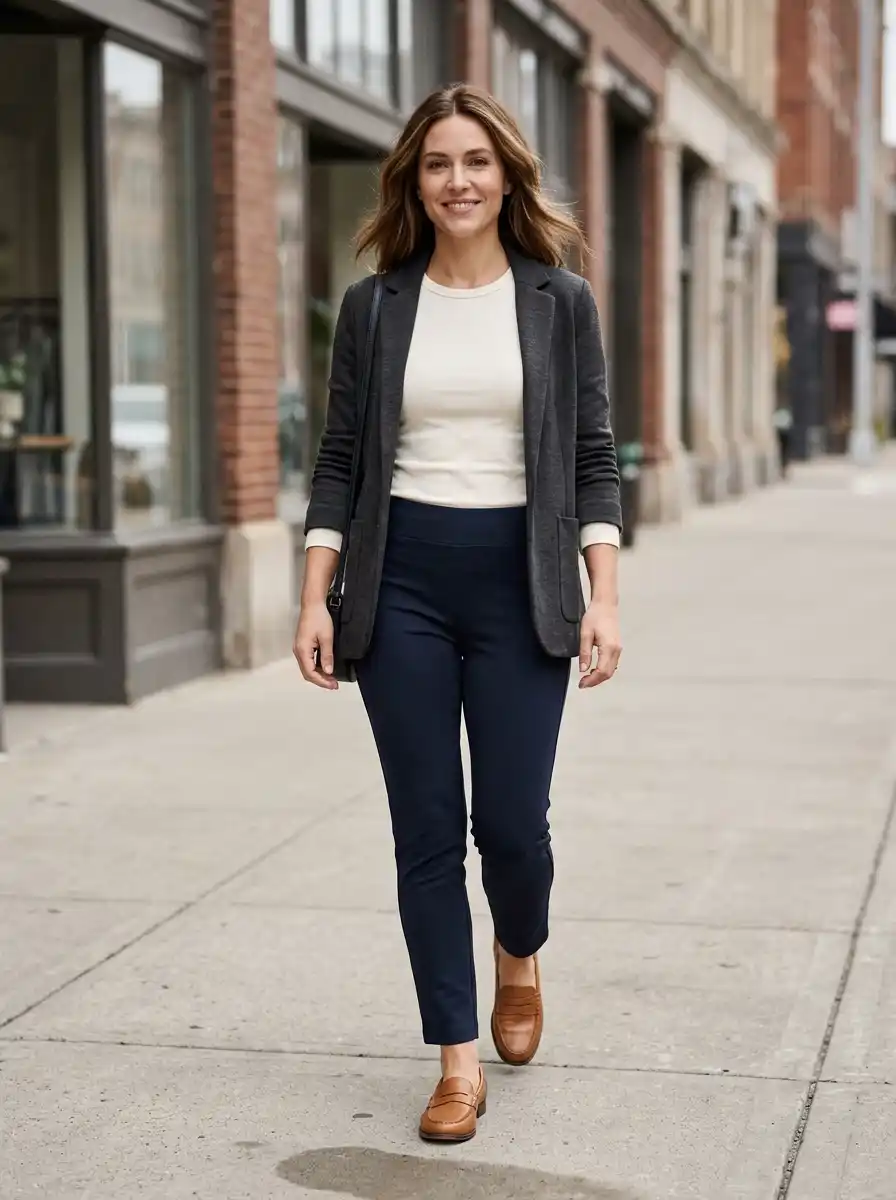
Five pieces that all mix with each other can carry you through a full month of outfits. These are bridge pieces, meant to fit you well now and keep fitting if you lose a bit more.
Look for fabric with 2 to 5% spandex or elastane on the tag. That stretch is what lets one size work across a few pounds. Buy by the brand’s size chart and your Step 2 numbers, not the size you used to wear.
- Dark ponte pull-on pants with a wide, flat waistband (about $30)
- Straight-leg jeans with stretch, in a medium wash (about $35)
- A faux-wrap knit dress, since the tie lets you tighten it as you shrink (about $35)
- A fitted long-sleeve tee in navy, cream or gray (about $15)
- A knit blazer that keeps its shape but stretches (about $30)
Target, Old Navy and resale apps all carry these at these prices. Keep every tag on until you have worn each piece around the house for one full day.
Swap baggy tunics for structured fabrics that skim loose skin on your arms and tummy

Big, flowy tops feel like the safe choice for loose skin. They actually make you look larger. Loose fabric drops straight down from the widest point of your bust, so your whole body reads as that width.
Fabric weight matters more than fit here. Choose ponte, crepe, denim, twill or thick cotton jersey. These are heavy enough to glide over skin without clinging to every fold. Thin, stretchy jersey and shiny satin show each ripple.
To test fabric at home, hold it up to a window. If you can clearly see light through it, it’s too thin to wear without a layer.
For your upper arms, pick sleeves that end at the elbow or the wrist, the narrower parts of the arm. Avoid sleeves that stop mid-bicep.
For your tummy, look for side ruching on tops and dresses, or high-rise pants with a flat front panel. A light smoothing camisole under a knit top adds a soft layer without squeezing.
Belt your new waist 1 inch above your belly button

Where is your waist now? Use the narrowest point you found in Step 2. For most women that’s about 1 inch above the belly button.
Your waist is often the first place weight loss shows. A belt tells everyone it’s there. Pick the width by torso length:
- Short torso (under three fingers between your bra band and waist): a 1-inch belt in the same color as your top
- Average or long torso: a 1.5- to 2-inch belt in a contrast color
- Wear it over the wrap dress, a tucked tee, or an open knit blazer
Old belts too long now? Shoe repair shops will punch new holes for a few dollars. A stretch belt with a hook clasp skips holes entirely.
When the Belt Makes Things Worse
A belt over a top that’s still too big bunches fabric above and below it, which adds bulk instead of removing it. Tuck the top first, or save the belt for pieces that already fit at the side seams.
Photograph your outfit from 6 feet away to see how you dress after weight loss over 40, not your old size

Mirrors are tricky after a big weight change. Many women say they still “see” their old body for months, even when every number has dropped. A photo is fairer.
Prop your phone on a shelf at waist height, in front of a window for soft light. Set a 10-second timer and stand 6 feet back. Take one shot from the front and one from the side.
Check three things on the screen. Shoulder seams should sit right at your shoulder bone. Hems should land where you planned. Look for pulling or sagging fabric at the bust, hips or seat.
Then pull up an old photo in a similar outfit and set the two side by side. That comparison often does more for confidence than any mirror.
Save every outfit that passes in a phone album called “Fits Now.” On busy mornings, open it and pick one. If you still can’t see the change after weeks of photos, that’s common, and a counselor who works with body image can help.
Your Challenge for This Week

You now know how to dress after weight loss over 40. You can find your real size, fix your bra, decide what to keep or tailor, and fill the gaps without overspending.
Here’s your challenge for the next seven days: pinch-test every pair of pants you own, and bag the Let Go pile before Sunday night.
Next weekend, give your blazers and dresses the same treatment.
Save this to your closet board on Pinterest so the cheat sheet is on your phone when you start pulling things off hangers.
What Readers Ask After Losing 20+ Pounds
I lost weight on a GLP-1 medication. Does anything change?
Fast loss often means sizes shift quickly and you may have more loose skin. The 6-week waiting rule matters even more for you, so lean on stretchy bridge pieces and resale shops until your weight holds steady.
The scale stopped moving, but my pants keep getting looser. Why?
If you strength train, your shape can keep changing while your weight stays the same. Measure your waist and hips once a month, and go by those numbers before you tailor anything.
Should I try on the “someday” clothes I saved from years ago?
Yes, put them through the same pinch test in Step 4. Expect some to look dated, especially jeans, because rises and leg shapes have changed. Keep only the ones that fit and still feel like you.
Do I need shapewear for loose skin on my stomach?
No, it’s optional. A light smoothing cami or high-rise brief gives a soft, even layer under knits. Skip firm compression pieces if they feel tight after an hour.
My rings keep spinning or slipping off. What can I do?
Slide a clear silicone ring sizer onto the band for now; they cost a few dollars online. Once your weight is stable, a jeweler can resize the ring for good.