What to Wear to a Job Interview Over 40

Your last job interview may have been before video calls and relaxed office dress codes. The rules have shifted, and nobody sent you the memo.
If you’re unsure what to wear to a job interview as a woman over 40, you’re in good company. You have the experience and the skills, yet the closet question still feels oddly stressful.
You might worry about looking dated. Or overdressed. Or like you’re trying too hard to be someone you’re not.
Here’s the good news. The goal is not to look younger. The goal is to look current, capable and like yourself.
In this guide, you’ll learn how to read any company’s dress code and which outfit suits your industry. You’ll also learn how to stay comfortable, how to dress for video calls, and how to prepare without last-minute panic.
Quick answer: Dress one step more formal than the company’s everyday style. A tailored blazer, a simple top, well-fitted trousers or a midi skirt, and polished closed-toe shoes work for most interviews.
Why What You Wear to a Job Interview Still Matters After 40

People form an impression of how competent someone looks in a split second. Clothing plays a big part in that snap judgment, even when people try to ignore it.
That isn’t fair, but it is useful to know. Interviewers are human, and they notice how you present yourself before you say a word.
For experienced candidates, there’s often an extra layer. Some interviewers make quick assumptions about energy, adaptability or how up to date someone is, based on appearance alone.
Women tend to feel this pressure more than men. Many women over 40 say they’re judged on looks in ways their male peers simply aren’t.
Here is the part that matters most. Bias is not your fault, and you can’t control it. Your outfit, though, is fully in your hands.
The right clothes do three jobs for you:
- They show you understand the company and take the role seriously.
- They signal that you’re current and engaged with today’s workplace.
- They let you forget about your clothes and focus on your answers.
There’s a personal benefit too. When you feel put together, it shows in your posture, your eye contact and your voice.
So before you shop or pull anything from your closet, find out what this employer actually expects.
How to Decode the Interview Dress Code Before You Shop

You got the interview. Now comes the closet question.
The safest rule is simple: dress one step more formal than the team wears day to day. If they wear jeans, wear smart trousers and a blazer. If they wear business casual, go slightly more polished.
Here’s how to find out what the team really wears:
- Check LinkedIn. Look at photos of current employees, especially people on the team you’d join.
- Browse the company’s social media. Team events, office tours and “meet the team” posts show real everyday clothing.
- Read the careers page. Culture pages and team photos often give strong clues.
- Ask the recruiter. It’s a normal question, and it shows good judgment.
If asking feels awkward, keep it short and friendly:
“Could you tell me what the team usually wears day to day? I’d like to dress appropriately for the interview.”
Industry matters a lot. Finance, law, insurance, banking and government still lean formal, and many interviewers there expect a suit.
Retail, construction, tech and creative fields are usually more relaxed. Even there, interviewers still want to see that you made an effort.
Location matters too. Offices in big financial cities tend to be more traditional than offices in smaller towns or tech-focused areas.
When in doubt, lean slightly more formal. You can always take off a blazer if you feel overdressed, but you can’t add polish once you’re in the room.
Once you know the dress code, pick your outfit formula below.
5 Interview Outfit Formulas for Women Over 40 (By Dress Code)
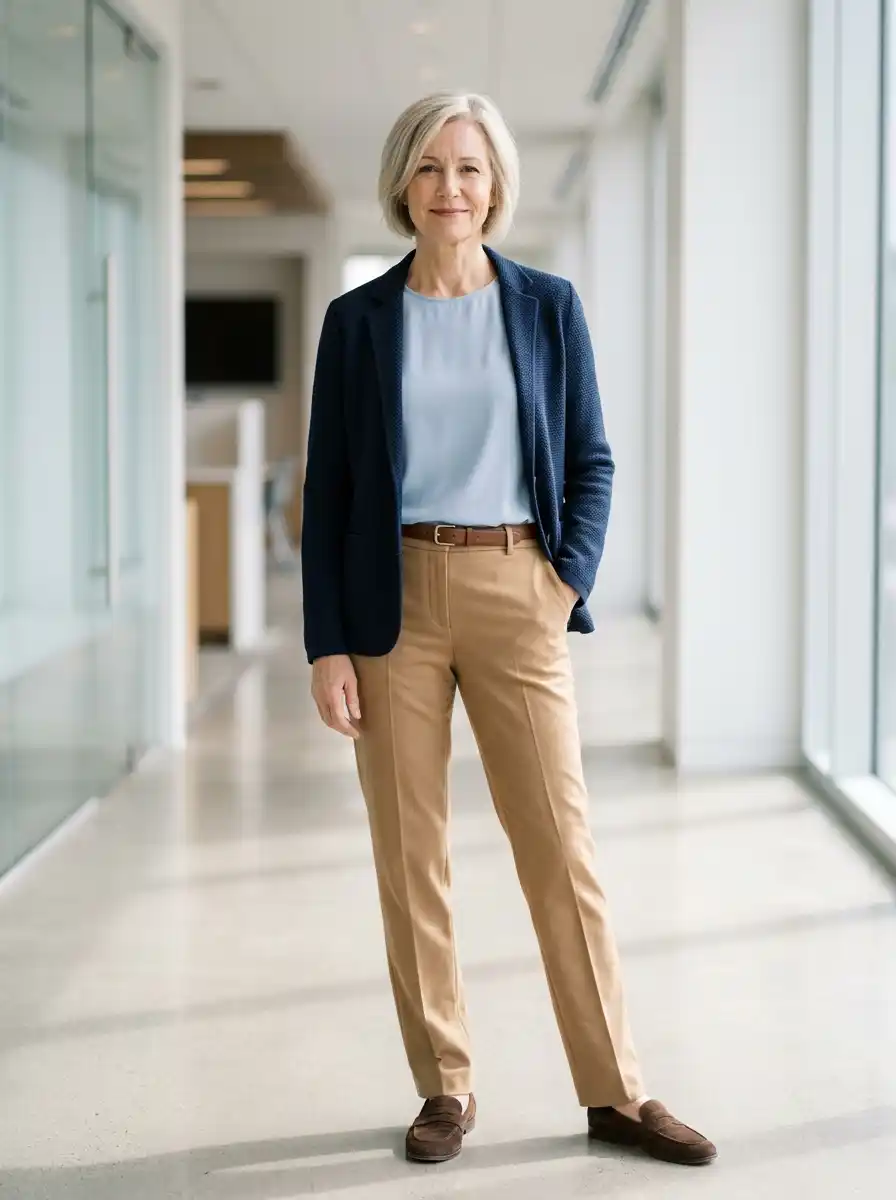
These five outfits cover almost every interview. Find your dress code in the table, then read the details below.
| Dress code | Outfit formula | Best colors | Shoes |
|---|---|---|---|
| Corporate / formal | Matching suit + plain shell or blouse | Navy, charcoal, black | Closed-toe pumps or loafers |
| Business professional | Tailored blazer + trousers + fine-knit top | Navy, gray, camel, burgundy | Low heels or leather loafers |
| Business casual | Blazer or knit blazer + blouse + trousers or midi skirt | Neutrals with one soft color | Loafers or low block heels |
| Tech / startup / creative | Soft blazer + quality knit or shirt + dark trousers | Dark neutrals, olive, rust, cobalt | Clean leather sneakers or loafers |
| Healthcare / education / nonprofit | Midi dress + cardigan or jacket, or trousers + blouse | Navy, teal, soft blue, warm neutrals | Comfortable flats or low heels |
1. Corporate or Formal
Best for: law, finance, banking, insurance, government and senior leadership roles.
A matching suit is still the standard here. Choose trousers or a knee-length skirt, whichever you feel most confident in.
Pair it with a plain shell, a silk-look blouse or a fine knit. Keep the neckline simple and the jewelry minimal.
Budget swap: Buy a blazer and trousers from the same fabric range of an affordable brand, then pay for tailoring. A well-fitted budget suit beats an expensive one that pulls.
2. Business Professional
Best for: consulting, HR, sales leadership, account management and client-facing roles.
You don’t need a full suit, but you do need structure. A tailored blazer with matching or contrasting trousers works well.
Add a fine-knit top or a crisp blouse and a structured bag. This outfit says “ready to meet clients today.”
Budget swap: One navy or charcoal blazer can anchor several outfits. Spend there, and save on tops.
3. Business Casual
Best for: most corporate offices, operations, marketing, admin and project roles.
This is the most common interview dress code, and the easiest to get slightly wrong. Aim for polished, not stiff.
Wear a blazer or a knit blazer over a blouse. Pair it with straight or wide-leg trousers or a midi skirt, and finish with loafers or low block heels.
Budget swap: A knit blazer can replace both a cardigan and a formal jacket, so it earns its place quickly.
4. Tech, Startup or Creative
Best for: tech companies, startups, design studios, media and agencies.
The team may wear hoodies, but you’re still the candidate. Choose dark, well-fitted trousers with a quality knit or a crisp shirt.
Add a soft, unstructured blazer to show effort without looking out of place. Clean leather sneakers or loafers keep it relaxed.
Only wear very dark, fitted jeans if you’ve confirmed the company is truly casual. When unsure, choose trousers.
Budget swap: One great knit in a rich color can lift simple trousers and make the outfit feel modern.
5. Healthcare, Education or Nonprofit
Best for: schools, hospitals, clinics, charities and community organizations.
These settings value approachability as much as polish. A sheath or wrap midi dress with a cardigan or light jacket works well.
Tailored trousers with a soft blouse are just as good. Pick comfortable, quiet shoes, since you may get a building tour.
Budget swap: A plain dress in a solid color can be restyled with different jackets for second and third interviews.
If you’re wondering what to wear to an interview over 50, these same formulas apply. Fit, fabric and condition matter far more than age.
Whichever formula you choose, the details decide whether it looks current.
How to Look Current, Not Dated (Without Chasing Trends)
Worried you’ll look like you’re wearing an interview suit from another decade? Usually the whole outfit isn’t the problem, just a few small details.
Fit Beats Everything
Dress the body you have today, not the one you had years ago. Clothes that pull, gape or sag look dated even when they’re new.
Set aside a small budget for tailoring. Hemming trousers, taking in a waist or shortening sleeves can make an affordable piece look made for you.
Update the Details That Date You Fastest
Interviewers rarely notice a jacket’s age, but they do notice these:
- Glasses frames: older styles stand out quickly, so consider a modern frame if you wear glasses daily.
- Bag: a worn or overly casual bag can undo a polished outfit.
- Shoe shape: very chunky heels or very pointy toes can look out of date.
- Trouser cut: straight and wide-leg cuts feel more current than tight or heavily flared styles.
What Feels Current Right Now
Modern tailoring is softer and easier to wear. Look for relaxed shoulders, fluid fabrics and jackets that move with you.
Waistcoats, longer blazers and midi skirts all feel fresh. Rich, grown-up colors like burgundy, forest green, deep blue and camel look polished without being loud.
| Do | Skip |
|---|---|
| Soft-shoulder blazer | Heavy shoulder pads |
| Straight or wide-leg trousers | Very tight or very flared trousers |
| Loafers or low block heels | Very high or very chunky heels |
| One rich color | Head-to-toe trend pieces |
| Simple, modern jewelry | Large, noisy accessories |
Add One Personality Piece
You don’t have to wear all black or all navy. One thoughtful detail, such as a silk scarf, bold earrings or a colored top, makes you memorable.
Keep it to one. A single standout piece looks confident, while several can look busy.
Accessories, Hair and Grooming
The small things are what interviewers notice up close. A quick check here makes a big difference:
- Condition: no loose buttons, pilling, creases, scuffed shoes or loose hems.
- Fragrance: wear very little or none, since strong scents can distract in a small room.
- Bag: choose one structured bag that fits a folder with copies of your resume.
- Jewelry: simple and quiet, with nothing that jingles when you move your hands.
- Nails: clean and tidy, whether polished or natural.
- Hair and makeup: polished and intentional, not a full makeover the day before.
Gray hair is a personal choice, not a requirement either way. What matters is a neat, well-kept style that feels like you.
Looking current also means feeling comfortable, which brings us to fabric.
Fabrics and Comfort: Dress for How You’ll Feel

Nothing derails focus like overheating halfway through an answer. Nerves, warm offices and hot flashes can all push your temperature up fast.
The fix is planning your outfit for comfort, not just looks. Here’s how.
Layer Smartly
Choose a top that looks complete on its own. That way, you can take off your blazer without feeling underdressed.
Avoid building the whole outfit around a jacket that must stay buttoned. Open layers are easier to adjust in the moment.
Pick Fabrics That Breathe
Heavy wool, silk and many shiny synthetics can trap heat against your skin. They look smart but can feel stifling under pressure.
Look for lightweight, breathable options instead:
- Lightweight cotton blends for shirts and blouses
- Linen blends for warmer months
- Fine, thin knits rather than chunky sweaters
- Modern moisture-wicking fabrics made for workwear
Pure cotton breathes well, but it can hold moisture once you’re warm. A blend often works better on a stressful day.
Watch Colors and Sheerness
Some colors show sweat quickly, especially light gray and pale, smooth fabrics. Navy, black, deep colors and soft prints hide it much better.
Check that thin tops aren’t see-through. Office lighting and camera lights are often brighter than your bathroom mirror.
Do the 20-Minute Test
Wear the full outfit at home for at least 20 minutes. Sit, stand, walk, reach forward and raise your arms.
Then check your underarms, back and waistband. If anything pulls, rides up or feels damp, swap it now, not on the day.
Break In Everything New
Never wear brand-new shoes for the first time to an interview. Wear them around the house a few times so they feel natural.
The same goes for new clothes. A quick trial run reveals itchy labels, stiff seams and buttons that pop open.
Pack a small comfort kit too: tissues, a hair tie, a small folding fan and a bottle of water.
The same comfort rules apply on camera, with a few extra tweaks.
What to Wear to a Video Interview Over 40

For a video interview, dress fully and choose solid, mid-tone colors. The camera only shows part of you, so every detail in that frame counts more.
Choose Colors That Work on Camera
Solid jewel tones and soft colors look best on screen. Try teal, cobalt, soft blue, berry, emerald or warm burgundy.
Some choices cause problems on camera:
- Stark white can glow and wash out your face.
- All black can lose detail and look flat.
- Tiny patterns and thin stripes can shimmer or flicker on screen.
- Shiny fabrics reflect light and look distracting.
Pick a color that stands out from your background. A blue top against a blue wall makes you blend in.
Dress From Head to Toe
It’s tempting to wear a blazer with pajama bottoms. Don’t risk it.
You may need to stand up, grab a document or fix your camera. Dressing fully also helps you feel and sound more professional.
Set Up Your Space
Your setup matters as much as your outfit. Follow these steps the day before:
- Face your light source. Sit facing a window or lamp so light falls evenly on your face.
- Raise the camera to eye level. Stack books under your laptop so you’re not looking down into the lens.
- Tidy your background. A plain wall, bookshelf or simple plant looks calm and professional.
- Check your sound. Use headphones with a microphone if your room echoes.
- Test the platform. Install the app, update it and join a test call with a friend.
- Record yourself for two minutes. Watch it back and check your outfit, lighting and framing.
Let Your Setup Speak for You
Some interviewers wrongly assume experienced candidates struggle with technology. A smooth, well-lit, glitch-free call quietly proves them wrong.
Joining on time, sharing your screen confidently and handling small hiccups calmly all show you’re comfortable with modern tools.
In person or on screen, the final polish comes from preparing early.
Your Interview Outfit Checklist: 48 Hours, Night Before, Morning Of
Use this simple timeline so nothing surprises you on the day. Save it or print it out.
48 Hours Before
- Try on the complete outfit, including shoes, bag and jewelry.
- Wear it for 20 minutes: sit, stand, walk and raise your arms.
- Fix anything that pulls, gapes or feels uncomfortable.
- Get quick tailoring done, or swap pieces that don’t work.
- Steam or press everything, and check for loose buttons or threads.
The Night Before
- Lay out your full outfit, down to underwear and accessories.
- Pack your bag: resume copies, a pen, a notebook, water and tissues.
- Add backups: spare tights, a stain remover pen and a hair tie.
- For video interviews, test your camera, lighting, sound and internet connection.
The Morning Of
- Get dressed early and leave plenty of buffer time, because rushing makes you feel hot and flustered.
- Do a final mirror check from the front, side and back.
- Take a few slow breaths, then focus on your stories, not your outfit.
The bottom line: Decode the dress code, pick the formula that fits, make fit and fabric work for you, and test everything early.
Knowing what to wear to a job interview as a woman over 40 frees you to focus on what really matters: your experience and the value you bring.
Pick your outfit formula now, try it on today, and keep this checklist handy for the night before.
FAQs
Can I wear jeans to a job interview over 40?
Only if you’ve confirmed the company is truly casual, such as some tech startups or creative studios. Even then, choose very dark, well-fitted jeans with a blazer and polished shoes. When in doubt, wear trousers.
Is a dress or a pantsuit better for an interview?
Both work well. A pantsuit suits formal and corporate settings, while a midi dress with a jacket suits healthcare, education and business casual offices. Choose the one you feel most confident and comfortable in.
What colors should a woman over 50 wear to an interview?
Navy, charcoal, camel and burgundy look polished in almost any setting. Add one softer color near your face, like soft blue, teal or berry, to look fresh and approachable.
Should I cover gray hair before an interview?
No, it’s entirely your choice. Interviewers notice a neat, well-kept hairstyle far more than hair color. Go with whatever makes you feel most like yourself.
Where can I get free interview clothes?
Nonprofits such as Dress for Success provide free interview outfits for women in many cities, often through a referral from a job program. Local career centers and community closets may also lend professional clothing.