
How to Declutter Your Closet After 40 (The Reset Method)


Look up how to declutter your closet after 40, and almost every guide gives the same advice: pull everything out, then decide what to toss. It sounds logical.
It is also why so many clean-outs end at 4 p.m. with a mountain of clothes on the bed and nothing decided.
After 40, that pile is harder to face. Your waist may have shifted. Your workdays may look different. Some fabrics now feel too warm by lunchtime.
Every piece you hold up asks a heavy question, and you get tired of deciding fast.
The Reset Method flips the usual order. You start with the clothes you already love and wear.
Those pieces become your standard, and everything else has to measure up to them. You make decisions faster that way, and you second-guess yourself less.
By the end, you will have:
- a closet that fits your body and your life today
- one dated box for the sizes you’re unsure about
- a short list of what to buy next
- a simple system that keeps the closet from filling up again
Plan on two sessions of about 2 to 3 hours each, ideally on back-to-back days. The physical work is light. The emotional part is harder, and the steps below are built with that in mind.
Your Reset, Clocked
Total Time
1 Weekend
2 sessions, 1 day apart
Active Time
4–6 Hours
2–3 hours per session
Difficulty
Light Work
Heavier on the heart than the hands
Set These Out Before You Open the Doors
Everything within arm’s reach, so you never stop mid-pile to hunt for a marker.
- ◆ 4 large bags or boxes labeled Keep, Donate, Sell, Tailor
- ◆ 1 box with a lid for “someday” sizes
- ◆ A full-length mirror near a window
- ◆ The bra you wear most days right now
- ◆ Your 2 most-worn pairs of shoes
- ◆ Sticky notes and a thick marker
- ◆ Your phone, charged, for photos
- ◆ A soft tape measure
- ◆ A kitchen or phone timer
- ◆ Water and a snack for the halfway point
- ◆ Optional: 30 matching slim hangers
No full-length mirror? Prop your phone on a shelf at hip height and take a timed photo. The camera is often more honest than a mirror anyway.
The Reset in 10 Moves
- Book a drop-off for the morning after
- Pick your 10 most-worn pieces
- Sort one category at a time, pants first
- Try on maybes: sit, reach, bend
- Seal someday sizes in one dated box
- Keep 3 sentimental pieces, photograph the rest
- Cap the tailor pile at 5
- Rehang keepers between eye and hip level
- Turn every hanger backward for 90 days
- Write a 5-piece gap list
Book a donation drop-off for the morning after your reset

Bags of donations have a way of riding around in the car trunk for a month. Then a favorite sweater sneaks back into the closet, and the whole reset quietly falls apart.
Decide where everything will go before you touch a single hanger:
- Donate: a charity shop, women’s shelter or clothing drive. Call ahead, because some only accept drop-offs on certain days.
- Sell: a local consignment shop or a resale app, for brand-name pieces in great shape.
- Recycle: stained, stretched or torn items go to a textile recycling bin. Many charity shops can’t sell damaged clothes, so those often end up as trash.
Next, put the drop-off on your calendar for the morning after your second session. A fixed date gives you a finish line. It also makes “I’ll decide later” much harder to say.
Before You Promise It to a Shop
Many consignment shops only take pieces from the last 2 to 3 years, and some want them clean, pressed and on hangers. Check their rules first, or your “sell” pile will come right back home with you.
Pick the 10 pieces you wore most this past month

Ten pieces is enough to show you how you really dress now. Check the laundry basket, the chair in the corner and the hooks behind the door first. Your most-worn clothes often never make it back to the closet at all.
Hang those 10 items together at one end of the rod, with an empty gap beside them. Then look at what they have in common.
Maybe they are all soft knits, all mid-rise, all navy and cream, or all pieces that skim your body instead of clinging to it.
Write those patterns on a sticky note and put it on the closet door. That note is your standard for the rest of the reset. In Step 4, every “maybe” piece gets compared to it.
Stuck at six or seven? Scroll through your phone photos from the last month. Your camera roll remembers your outfits better than you do.
Declutter your closet after 40 one category at a time, pants first
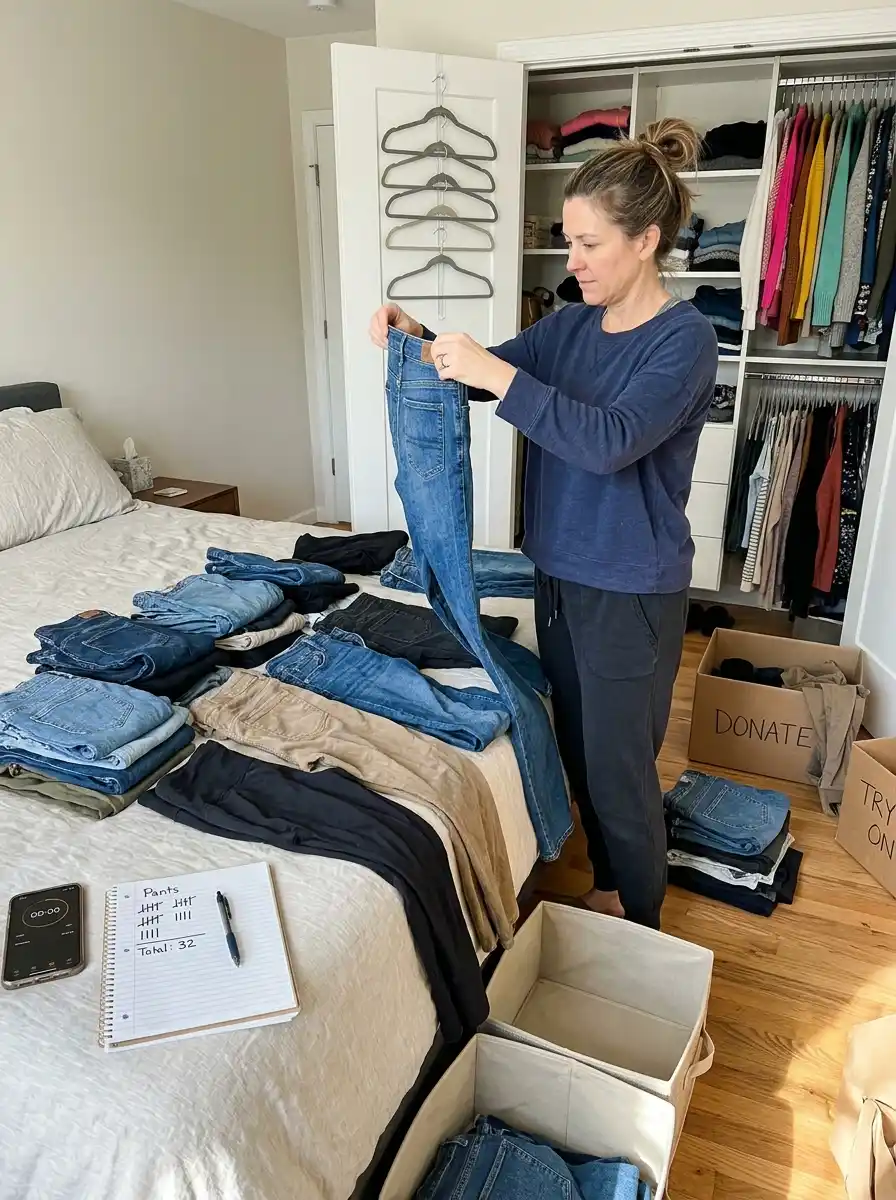
If the whole closet comes out at once, you lose the bed, the floor and most of your patience by noon. Working one category at a time keeps the mess small enough to finish.
Pants and jeans go first for a reason. Waistbands are often where midlife body changes show up first, because weight tends to shift toward the middle during perimenopause and menopause.
That makes pants the quickest category to sort: a pair either buttons comfortably or it doesn’t.
Lay every pair on the bed, including the ones folded in drawers or stored in bins under the bed. Count them. The total usually surprises people.
Set your timer for 45 minutes for each category. When it rings, stop and take a 10-minute break, even if you aren’t done. Decisions made while you’re tired tend to be “keep it all” decisions.
After pants, sort tops, then dresses, sweaters and jackets. Save shoes and bags for last, since they usually carry the most “but I paid so much” guilt.
The last batch opened with an observation, a number and a condition. This batch opens with a question, a quoted thought and a string of objects, and the step lengths vary more.
Try on every maybe in daylight, then sit, reach and bend

Does it fit now, or did it fit five years ago? Daylight gives you the honest answer. Stand near a window, put on the bra you wear most days, and slip on one of your two everyday pairs of shoes.
An old bra or a fancy heel makes clothes look better than they will on a normal Tuesday.
Put on each maybe piece and test it with three moves: sit on the edge of the bed, reach both arms overhead, and bend as if you were picking up a dropped key.
Then pay attention to the fabric. If it feels warm or scratchy after 2 minutes, it will feel worse halfway through a busy day or a hot flash.
If the waistband digs in when you sit, let it go. You spend far more hours sitting than standing in front of a mirror.
If it fits but feels too stiff or too young, hold it next to your sticky note. If it doesn’t match your patterns, it goes.
If it passes all three moves, hang it with your keepers.
If one thing is off, like the hem or a loose waist, set it in the tailor pile.
Still on the Fence?
Ask yourself one question: if I saw this in a shop today, would I pay full price for it? A slow, hesitant “maybe” is usually a no.
Seal someday sizes in a single dated box
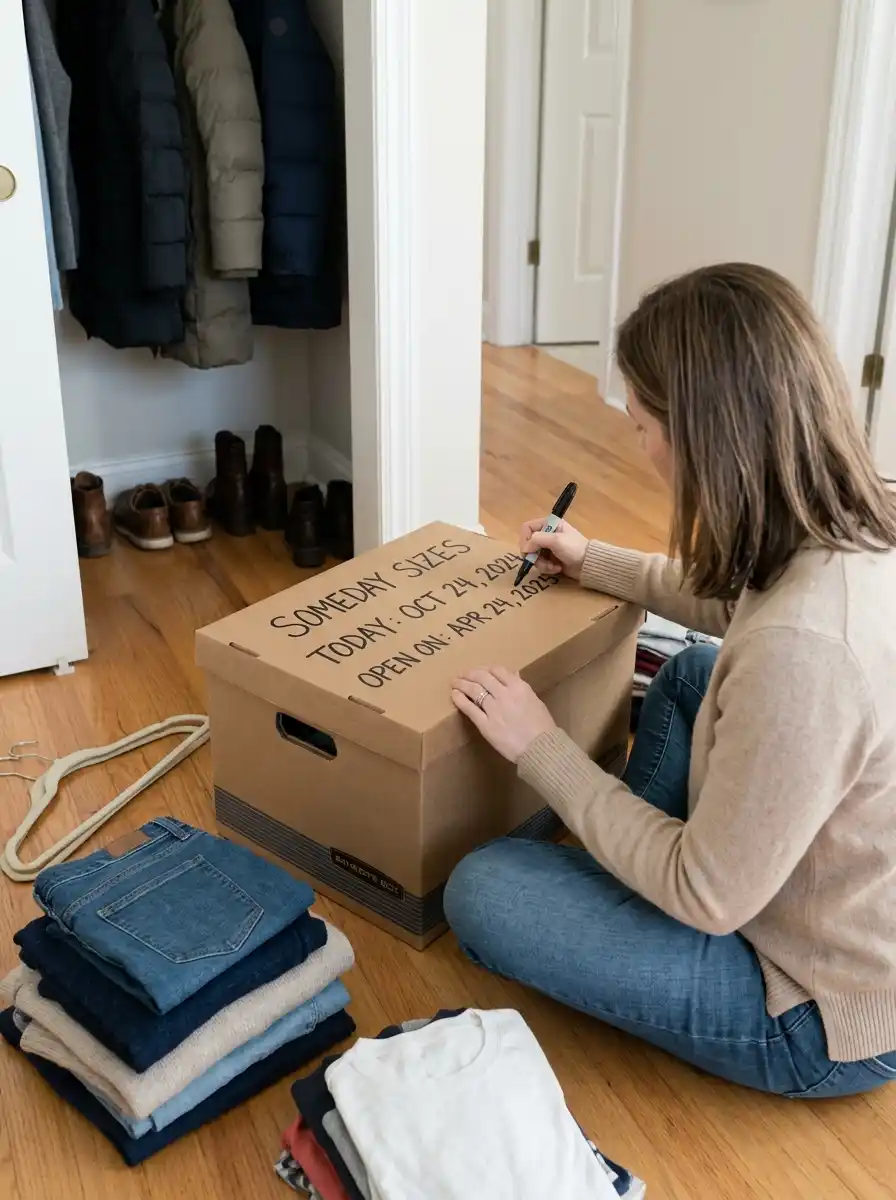
“When I lose 10 pounds…” is a hard thought to argue with, so this step doesn’t argue. It gives those clothes a waiting room instead of closet space.
Fold every piece that is one size too small or too big into your lidded box. On the lid, write today’s date and a second date 6 months from now in thick marker. Store the box outside your bedroom, in a hall closet, the garage or under a guest bed.
When the second date arrives, open the box. Keep anything that fits and that you missed. Anything you forgot was in there goes to donation without a try-on.
Bodies shift a lot after 40, so this box isn’t a sign that you failed. It lets you decide later, calmly, instead of today in a hurry.
One Box, One Size
Store only one size up or one size down from what you wear now. A box holding three size ranges turns into a second closet, and the guilt moves in with it.
Keep three sentimental pieces so the rest can leave with a photo

The blazer from your first real job. The dress you wore to your daughter’s graduation. Your mother’s cardigan with the pilled sleeves. Pieces like these stopped being clothes a long time ago, which is why they are the hardest to sort.
Gather every sentimental piece in one spot on the bed. Choose the three that matter most to you today, not the ones you feel you should keep. Those three get a permanent place in the closet or a keepsake box.
Photograph everything else before it leaves. Lay each piece flat or hold it up in the mirror and take the picture. Save the photos to one phone album called “Closet Memories.” You keep the memory, and the fabric gets to live on with someone who will wear it.
Before anything goes to donation, ask whether a daughter, niece or close friend would love to have it. A cardigan in a drawer means less than one worn every winter by someone you love.
This batch changes up the openers again: a cost comparison, a blunt observation and a short claim about memory. Only one step uses a list, and the lengths run long, short, long.
Cap the tailor pile at five pieces worth fixing

A $20 hem on $30 pants is a smart fix. A $60 rebuild on a $50 dress is not. Use this rule: if the alteration costs less than one-third of what you’d pay to replace the piece, fix it. If it costs more, let the piece go.
Some alterations nearly always pay off, and others rarely do:
- Worth it: hemming pants, taking in a waist that gaps at the back, shortening sleeves, swapping cheap buttons for better ones.
- Rarely worth it: letting out a tight waist (most seams don’t have enough extra fabric), reshaping jacket shoulders, or rescuing knits that are pilled or stretched out.
Stop at five pieces. Tailor piles tend to grow and never get finished, and five is a load you can carry in one trip.
Drop them off the same morning as your donations. Pin a note to each piece that says exactly what you want, like “hem to ankle bone, worn with flats.”
Rehang keepers between eye level and hip level
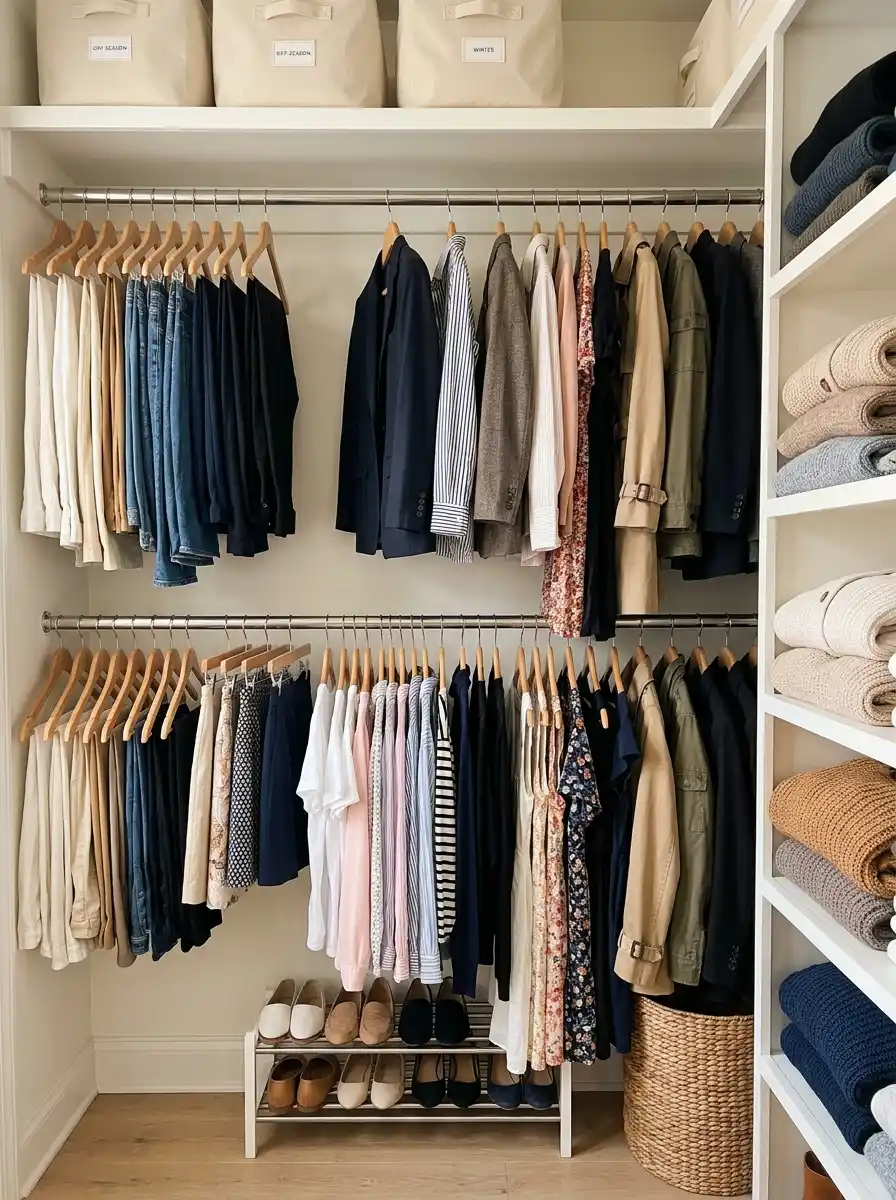
Top shelves and closet floors are where good clothes go to be forgotten. The section you see the moment the doors open is the section you’ll pull from every morning.
Hang your keepers by category: pants, skirts, tops, dresses, then jackets. Within each group, go from light to dark so you can spot a color in seconds. Put your 10 benchmark pieces front and center.
Fold heavy sweaters and knits on a shelf instead of hanging them. Hangers stretch out the shoulders and leave little bumps that never fully go away.
Pack off-season pieces into a bin on the top shelf. Swap them back down when the weather turns.
The Hanger Swap
Matching slim velvet hangers take up far less room than chunky plastic ones, and silky blouses stop sliding to the floor. A row of the same hanger also makes a half-empty closet look calm instead of bare.
Turn every hanger backward for the next 90 days
Memory is a generous liar. You feel like you wear the green blouse all the time, but it may have been out twice since spring. This old trick replaces the guess with proof.
Turn every hanger in your closet so the hook faces you, the opposite of how you’d normally hang it. When you wear a piece and put it back, hang it the regular way. Leave everything else alone.
Set a phone reminder for 90 days from today. When it goes off, look at the rod. Anything still hanging backward had three months of chances and didn’t get picked.
Give each of those pieces one honest question: is it out of season? If yes, give it until that season ends. If no, it goes in the next donation bag, without a final try-on to talk yourself out of it.
The trick only covers your main closet. The someday box and the off-season bin keep their own dates.
The last opener was a claim about memory, so this one opens on a familiar moment instead. This is the only list since Step 7.
Write a five-piece gap list before you shop again
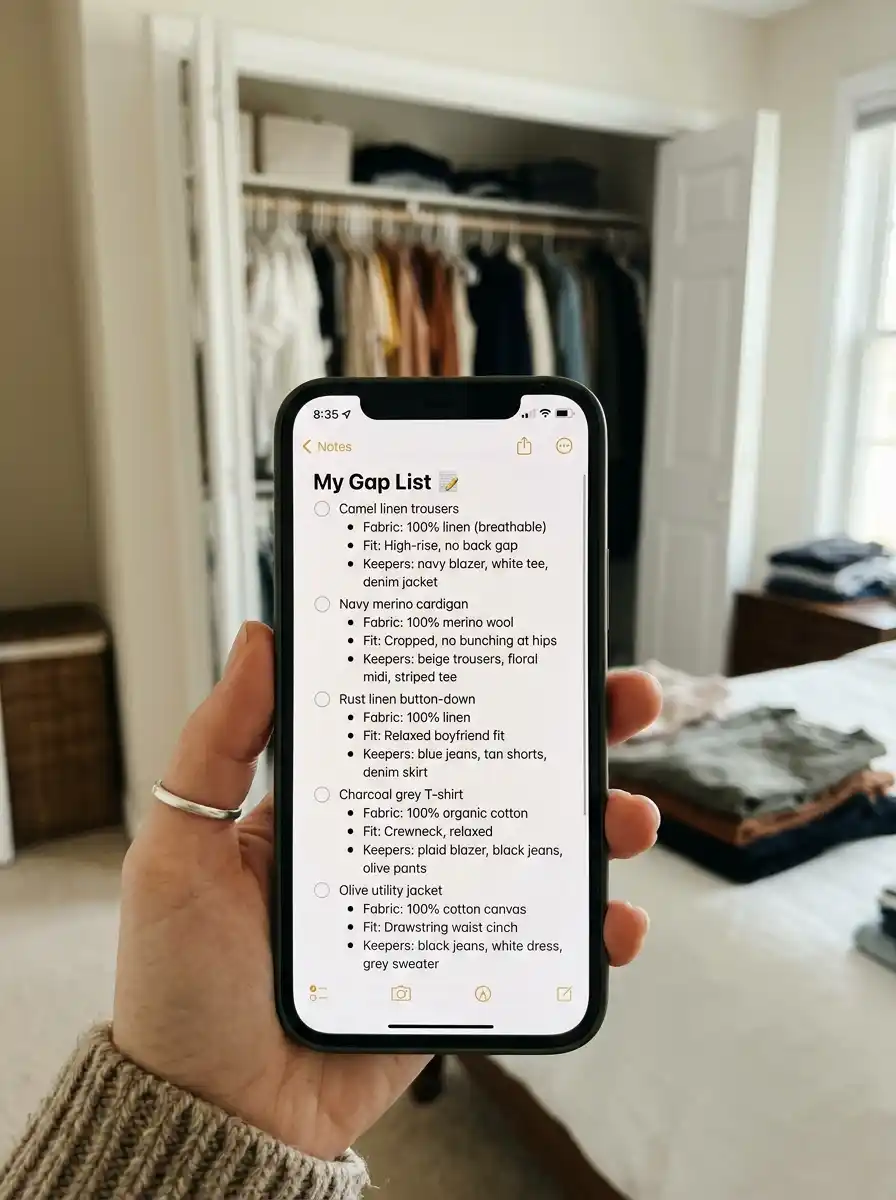
The first weekend after a reset, sale emails suddenly look very tempting. Empty space on the rod feels like an invitation to fill it. This step makes sure the next thing you buy fills a real gap, so you don’t start the old pile all over again.
Look at your keepers and think back over the past month. What did you reach for and not find? Maybe it was pants that pass the sit test, a warm layer for a chilly office, or flats that work with your dresses.
Write down no more than five items in your phone’s notes app, and add these details for each one:
- the exact color, like “camel,” not “neutral”
- a fabric that breathes, like cotton, linen or merino
- the fit detail that matters, like “mid-rise, no gap at the back”
- 3 keepers it will go with
If you can’t name three keepers for an item, leave it off the list. And every time you buy something from the list, donate one older piece from the same category.
What Women Over 40 Ask Before Letting Clothes Go
Should I keep my pre-menopause sizes?
Keep one size range, not every size you’ve worn. Put it in the dated box from Step 5 and decide in 6 months, when you’ll have a clearer picture of where your body has settled.
My weight changes month to month. What should I keep?
Favor pieces that adjust with you: wrap dresses and tops, pull-on pants with a flat elastic waist, and tops with a little stretch. Fixed waistbands and fitted button-up shirts tend to be the first things to stop working.
How many pairs of jeans is enough?
Keep the pairs you actually rotate, which for many women is two or three. One dark-wash pair that can be dressed up covers most nights out.
Can I do the whole reset in one afternoon?
You can sort a small closet in one long session, but your choices get weaker after about 2 hours. If one afternoon is all you have, do pants and tops today and save the rest for next weekend.
What about clothes I loved in my 30s that feel too young now?
Try the piece on with your current shoes and a jacket from your keepers. If it works styled that way, it stays. If it only works with the outfit you wore it with back then, it’s done its job.
Screenshot or Print Me
Your Reset Cheat Sheet
Have Ready
- 4 labeled bags or boxes
- 1 lidded “someday” box
- Mirror by a window
- Everyday bra + 2 pairs of shoes
- Sticky notes + marker
- Phone for photos
- Tape measure + timer
The Moves
- Book the drop-off for the morning after
- Hang your 10 most-worn pieces as the standard
- Sort one category per 45 minutes, pants first
- Try on maybes: sit, reach, bend, feel the fabric
- Box someday sizes, dated 6 months out
- Keep 3 sentimental pieces, photograph the rest
- Tailor 5 max, if the fix costs under 1/3 of replacing
- Rehang between eye and hip, light to dark
- Flip hangers backward, check in 90 days
- Write a gap list of 5, each matching 3 keepers
Conclusion
Your closet now holds clothes that fit the woman you are today, plus a dated box, a short tailor list and a five-piece plan for what comes next. That’s how to declutter your closet after 40 without second-guessing every hanger.
Here’s your challenge for this week: find three keepers you’d forgotten you owned and wear each one before you buy anything on your gap list. At least one of them will probably become a new favorite.
Save this guide to your closet or wardrobe board on Pinterest so the cheat sheet is ready when your 90-day hanger check comes around.