
How to Wear All Black Over 40 Without Looking Severe


Black ages you after 40. That line shows up in magazines every fall, and it’s only half right. Black isn’t the problem. Flat black is.
One dull fabric, a high neck, heavy boots and nothing light near your face add up to a tired, stern look in photos. Learning how to wear all black over 40 mostly means fixing those four things.
I wore black almost every day for years before I worked this out. My favorite black sweater and trousers looked chic on the hanger. In pictures, I looked like I was on my way to a hard meeting. The clothes were fine. The way I put them together wasn’t.
This guide takes you through nine small changes in order, with a quick check after each one. You start by photographing what you wear now.
Then you change one thing at a time: fabric, neckline, skin, shoes, metal and lips. You finish with a second photo to compare. You keep the sleek all-black look, and your face gets its warmth back.
Plan on 25 to 30 minutes the first time. Once you know your formula, getting dressed takes under 10 minutes.
Same clothes, different choices
Harsh Black vs. Softened Black
Before: Looks Severe
- One dull fabric from neck to shoes
- High crew or turtleneck close to the chin
- Sleeves past the wrist, pants pooling on the shoe
- Chunky black boots that weigh the outfit down
- Metal that fights your skin tone, or no jewelry at all
- Nude lips that disappear against the black
After: Looks Soft
- Two or three textures that catch light
- V or scoop neck that shows the collarbone
- About 2 inches of wrist and ankle showing
- A loafer, flat or slim boot
- Gold or silver chosen for your undertone
- Lips one shade brighter than usual
Lay These Out by the Window First
Gather everything before you start so you can swap pieces without leaving the light.
- Your go-to all-black outfit, shoes included
- Every other black top, pant, skirt and dress you own
- One black piece with sheen (silk or satin)
- One black piece with texture (rib knit, cable knit or leather)
- A black V-neck or scoop-neck top
- Ankle-length black pants, or a pair you can cuff
- A lighter shoe: loafer, ballet flat or slim-heeled boot
- One gold piece and one silver piece of jewelry
- 2–3 lipsticks, one a shade brighter than your usual
- Your phone, camera open
- A full-length mirror near a window (optional)
Photograph your current all-black outfit in window light

Your bathroom mirror isn’t a fair judge. Overhead bulbs cast shadows under your eyes and make black look even darker than it is. Daylight shows what other people see.
Put on the black outfit you wear most, shoes and all. Stand about 3 feet from a window, facing it, so the light falls straight onto your face. Prop your phone at chest height or hand it to someone.
Take two photos: one full-length and one from the waist up.
Don’t fix your hair or put on lipstick first. You want an honest starting point, not your best day.
Open the waist-up shot and notice where your eye lands. If it goes to the black before your face, you’ve found the problem this guide fixes. Save both photos, because you’ll compare them in Step 9.
Sort your blacks in daylight — and retire the faded ones
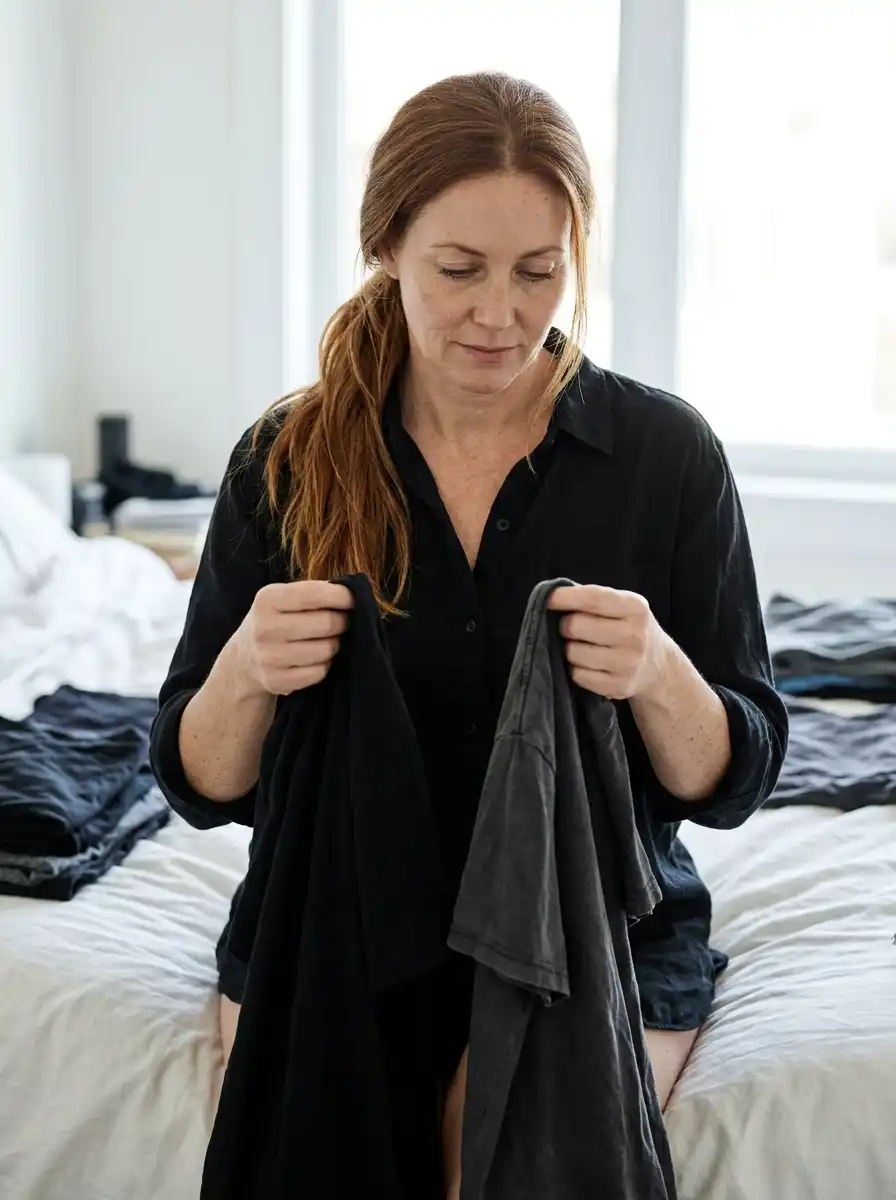
Three or four hot washes can turn black cotton a dull charcoal. You stop noticing because you see the piece every day. Daylight shows the fading fast.
Lay every black item you own across your bed, close to the window, with the pieces side by side and touching so you can compare them.
- Look for black that has turned gray, greenish or rusty brown.
- Check the knees, seat and underarms, which fade first.
- Run your hand over the fabric to feel for little fuzz balls (pilling), which dull black even when the color holds.
Move anything faded or fuzzy into its own pile. These pieces aren’t trash. A faded black tee under a camel coat looks relaxed. Inside an all-black outfit, though, it sits next to deeper black and makes the whole look tired and mismatched.
If you love a faded cotton piece, a box of black fabric dye from a craft store (about $5 to $8) can bring it back in one wash.
The Wash Habit That Keeps Black From Going Gray
Turn black clothes inside out and wash them in cold water on a gentle cycle with a detergent made for darks. Hang them to dry instead of using the dryer, because heat fades black faster than anything else.
Swap one matte piece for silk, rib knit, or leather

When every piece is the same dull cotton or jersey, black reads as one flat shape. People see the outfit before they see you.
Texture breaks that up. Silk reflects light, rib knit makes tiny lines of shadow, and leather has a soft gleam. Put two of these side by side and the eye sees layers and shape instead of a dark block.
Keep your base outfit from Step 1 and change one half of it. Pair a satin skirt with your matte sweater, a rib-knit top with smooth wool trousers, or a silk blouse tucked into black jeans.
Aim for at least two textures and no more than three. Four starts to look busy.
No silk in your closet? Any blouse with a slight sheen works, even polyester. A black velvet headband or a leather belt also counts as a texture.
Shiny Fabric Near the Face Needs a Matte Partner
High-shine satin right under the chin can catch every crease and make it look deeper. If your shiny piece is a top, keep the neckline open and pair it with a matte bottom. For full shine, put it on the skirt or pants instead.
Check the result in daylight: can you see where your top ends and your bottom starts? If you can, the swap worked.
Open the neckline so it dips 3 inches below your collarbone
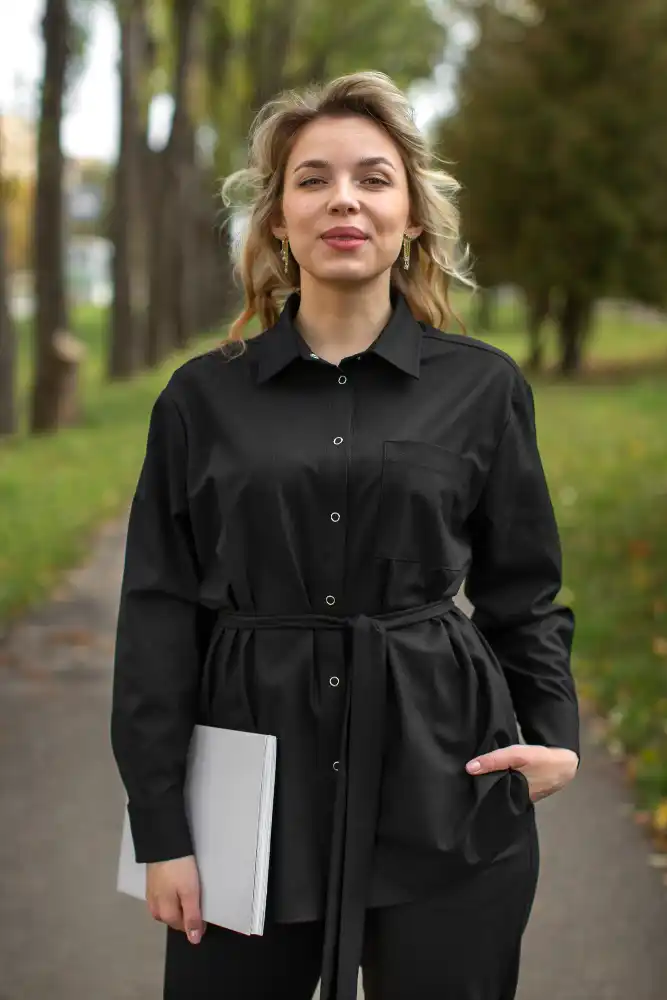
Where does the black stop on you? If the answer is “right under my chin,” that’s the biggest reason the outfit looks severe.
Black sitting close to the jaw works like a dark frame. It throws shadow up onto your face and makes skin look paler. A strip of bare skin between your face and the black gives the light somewhere to land.
To measure, lay four fingers flat across your chest, starting at your collarbone. That’s about 3 inches. Your neckline should reach at least the bottom of your fingers.
No V-necks in your closet yet? Try one of these with what you own:
- Undo the top 2 buttons of a black shirt.
- Button a cardigan from the middle down and leave the top 3 buttons open.
- Wear an open blazer over a black camisole instead of a crew-neck tee.
If you can’t give up turtlenecks in fall, pick a thin, fine-knit one and wear your hair up or tucked behind your ears. That puts more skin and more light near your face.
Show 2 inches of wrist and ankle

A friend once told me my all-black outfits looked “stylish, but in mourning.” The change that helped most was smaller than I expected.
Wrists and ankles are the narrowest parts of your arms and legs, and they tend to stay slim after 40. Showing them breaks a long black column into pieces and tells the eye there’s a real shape underneath.
Push your sleeves up until the edge sits about 2 inches above your wrist bone. Scrunch knits, and roll shirt cuffs twice.
Pants should end right at the ankle bone. If yours are too long, cuff them once, about 1½ inches deep.
On cold days, cover your ankles with a fine charcoal sock and let your wrists do the work.
Lighten the shoe if your outfit feels heavy below the knee
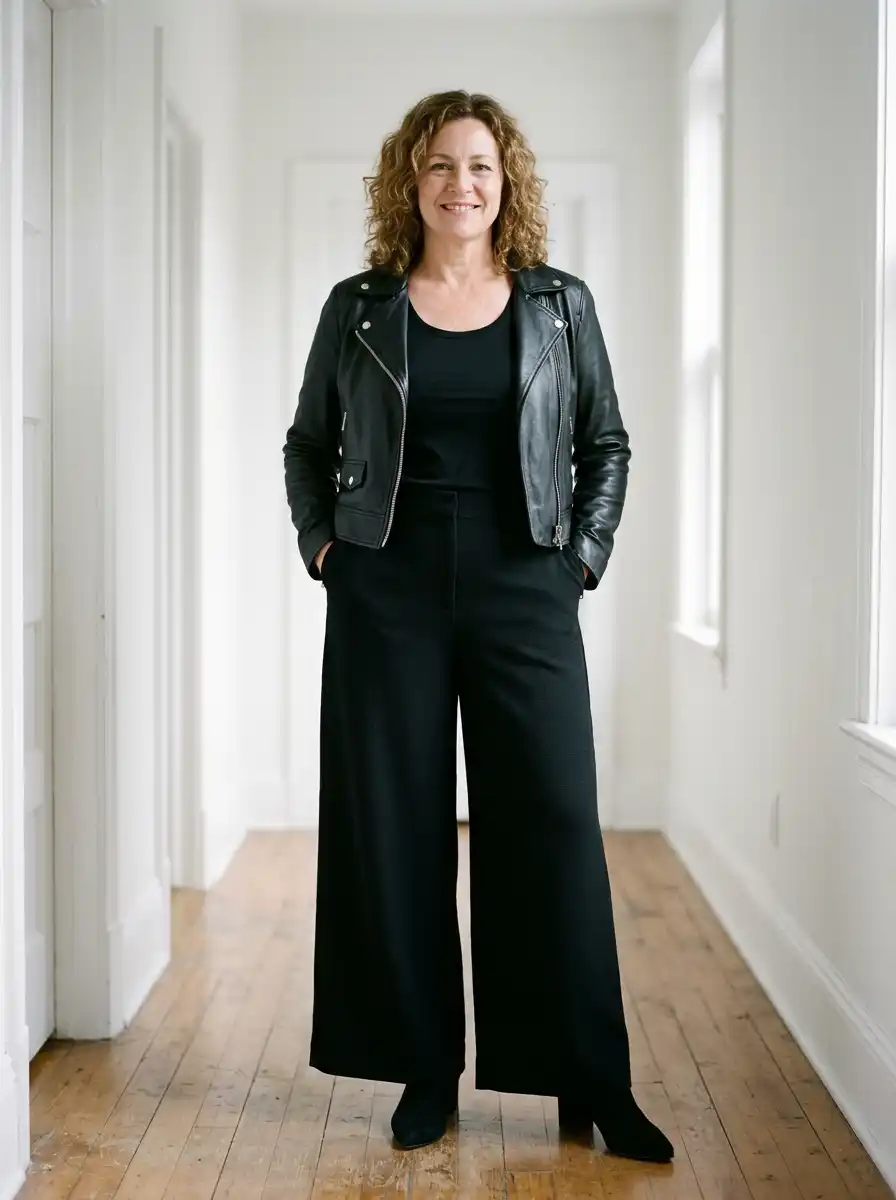
Cover the top half of your full-length photo from Step 1 with your hand and look only at the bottom. If your feet seem to sink into the floor, the shoes are too heavy for the outfit.
Chunky lug soles and thick round-toe boots pile black right where the eye finishes reading your outfit. That weight drags everything down and makes the whole look feel stern.
The right swap depends on what you’re wearing on the bottom.
If you’re in slim pants or a pencil skirt, try a pointed-toe loafer, a ballet flat or a slim ankle boot. A pointed toe makes the leg look longer.
If you’re in wide-leg trousers or a long skirt, pick a shoe with a little lift, like a block heel of 1½ to 2 inches, so the fabric hangs clean instead of puddling at the floor.
Hem Wide-Leg Pants for the Shoe You’ll Wear Most
Trousers hemmed for heels will drag on the ground with flats, and dragging hems look sloppy fast. Pick the shoe you’ll wear with them most often and hem them so the fabric sits about ½ inch above the floor in that shoe.
Do your knees need cushioned soles, or will you be walking all day? Keep the comfort and choose black suede or patent leather instead. The texture breaks up the weight the same way silk did in Step 3.
Hold gold, then silver, under your chin

Two pieces of jewelry and about 30 seconds of window light will tell you which metal belongs with your black.
Metal near the face bounces light back up onto your skin. The right one makes you look rested. The wrong one can make skin look gray or a little yellow, which is the opposite of what you need next to black.
Stand in the same window spot from Step 1. Hold the gold piece flat under your chin for 10 seconds and look at your skin, not the jewelry. Then do the same with the silver.
If gold makes your skin look warmer and the shadows under your eyes softer, you have a warm undertone. Gold hoops, gold buttons and a fine gold chain are yours.
If silver does that, your undertone is cool. Reach for silver, pewter or white pearls.
If you can’t see a difference, you’re likely neutral, so rose gold or a mix of both will work.
Choose earrings at least ½ inch across, or a necklace that sits inside the open neckline from Step 4.
Brighten your lips one shade past your everyday

Black pulls color away from the face. Your lips are the simplest place to put some back without breaking the all-black look.
Test 2–3 lipsticks in window light. Skip the nude that matches your skin, because next to black it disappears and leaves your face looking pale.
Use your result from Step 7 to narrow the shade. Warm undertones look best in coral, terracotta or brick red. Cool undertones suit rose, raspberry or berry.
Stay away from very dark plum or near-black lipstick. Dark lips plus black clothes bring the severe look right back.
Keep Brighter Lipstick From Bleeding Into Fine Lines
Outline your lips with a liner that matches the lipstick before you apply color. The liner works like a fence, so the brighter shade stays put and looks crisp, not smudged, by lunchtime.
Retake the photo so your face, not the black, pulls focus

Side by side, your two photos should look like the same woman on a much better day.
Go back to the window spot from Step 1 and stand the same 3 feet away. If you can, shoot at the same time of day, because light changes a lot between morning and evening and can skew the comparison.
Take the same two photos: one full-length and one from the waist up. Put each new photo next to its match from Step 1 and ask yourself:
- Where does your eye land first, on your face or on the clothes?
- Can you see where your top ends and your bottom begins?
- Do the shadows under your eyes look lighter?
- Do the shoes still seem to sink into the floor?
If one answer still feels off, go back to that one step. You don’t need to start over.
Save the final full-length photo in its own album. Next time you get dressed in black, copy it.
Three Days, Three Textures
You now know how to wear all black over 40 in a way that frames your face instead of hiding it. The black stays, and the heaviness goes.
Here’s your challenge for this week: wear your new formula three times and change only the texture. Try satin on one day, rib knit on another and leather on the third. Snap a window-light photo each morning and notice which version you reach for again.
Once this feels natural, try the same nine steps with deep chocolate brown. The rules carry over.
Pin this guide to your fall outfits board so it’s there the next time black starts to feel harsh.
FAQs
Your All-Black Questions, Answered for Fall
Does charcoal or deep navy count when I’m wearing all black?
Yes, as long as it’s one piece. A charcoal sweater with black pants softens the look without breaking it. Navy beside black works best when the two have different textures, so it looks chosen rather than mismatched.
Does black still work once my hair goes gray or silver?
It works well, because silver hair against black makes a sharp, polished contrast. Lean toward silver jewelry or pearls near your face, and keep your lip color bright enough that your face doesn’t fade between the two.
Can I wear black tights, black boots and a black dress together?
Yes. Choose sheer tights around 20–30 denier (a thin, see-through weight) so a hint of skin shows. Pair them with a matte dress and suede boots so each layer looks different.
Is all black too much for a daytime brunch or a school event?
Not if you keep the textures relaxed: cotton, knit and soft leather work in daylight better than satin. Add a loafer or flat and small gold or pearl earrings, and it reads as polished, not evening.
Most of my black tops are crew necks. Do I need to replace them?
No. Wear them under an open blazer or a cardigan left unbuttoned at the top, which creates a V shape over the crew neck. When a crew neck wears out, replace it with a V or scoop neck.