
What to Wear to Work When You’re Over 40


You know how to dress. That was never the problem. The problem is that the rules moved. Your office dress code probably changed in the last year.
Trends moved faster than your closet did. And your body, your job, and your confidence might not match the wardrobe you built ten years ago either.
This guide will not tell you to dress your age or hide anything. It gives you a system: what to keep, what to buy, what your specific office actually expects in 2026, and outfit formulas you can copy this week.
No trend chasing. No guesswork. Just a wardrobe that works as hard as you do.
If you searched “what to wear to work over 40,” you have probably found articles with 25 random outfit photos and nothing else.
This one gives you the reasoning behind the outfits, so you can keep making good choices long after you close this tab.
The Workwear Capsule
Build a sharper, smarter wardrobe designed for your actual office, changing trends, and maximum authority. Zero guesswork required.
1. Build the 8-Piece Foundation
Start with a core capsule: a well-fitted blazer, dark trousers, a knit dress, and a structured coat. Fewer pieces that mix seamlessly mean you stop making stressful daily decisions.
2. Adopt Soft Suiting & Muted Metallics
Skip the stiff power suits of the past. Embrace collarless blazers and relaxed matching sets. Add authority with intentional, singular metallic accessories.
3. Dress for Your Actual Dress Code
With 63% of formal codes shifting to business casual, adaptability is key. Keep a high-quality spare blazer at your desk to instantly elevate any smart-casual outfit.
4. Prioritize Fit, Fabric, & Comfort
Don’t hide your body—dress for how it feels today. Budget for $30 alterations to perfect your hems and waists, and choose textured, breathable fabrics with a hint of stretch.
Why Does Dressing for Work Feel Harder Right Now?
It is not just you. Dress codes have actually changed.
A January 2025 survey of more than 1,300 U.S. workers by Monster found that 43% had not worked under a formal dress code in the past year.
Among workers who did have one, 61% said it had shifted recently. If you feel like the goalposts moved, they did.
Across the workforce, business casual is now the most common standard. Casual dressing and uniforms make up most of the rest.
Full business formal, the stiff suits and heels version of “professional,” is now rare.
There is a second layer here worth naming honestly. A 2024 survey by Women of Influence+, covering more than 1,250 women across 46 countries, found that 77.8% had faced discrimination linked to their age at work.
That is not a small number. It means how you show up in a meeting still gets judged, sometimes unfairly, based on age.
This is not a reason to dress younger or try to disappear. It is a reason to dress like someone whose experience is worth taking seriously.
A sharp, current wardrobe is not about looking 25. It is about walking into a room with clothes that match your actual authority.
Once you know the rules changed, the fix is not a longer list of rules. It is a smaller, smarter wardrobe that flexes no matter what your office decides this quarter.
How to Build a Work Capsule Wardrobe After 40
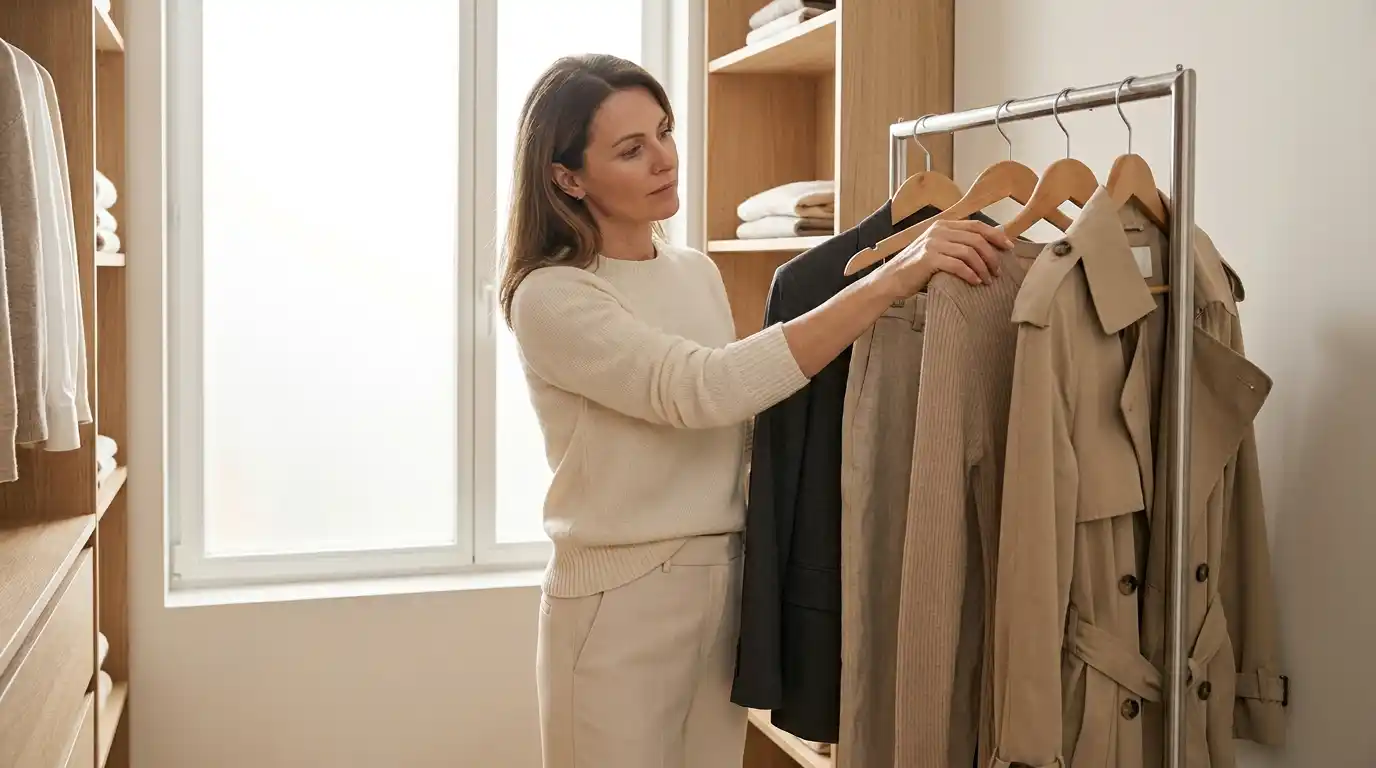
A capsule wardrobe is simple: a small set of pieces that all work together, so getting dressed stops being a daily decision.
One method worth trying, especially if you are not ready to spend money yet, is the 3-3-3 method. Pick 33 items and wear only those pieces for three months.
It has spread widely on TikTok and Instagram because it forces you to notice what you actually reach for, instead of what just takes up space.
Before you try any method, though, you need a foundation. Here are the 8 pieces that build the most outfits with the least effort:
- One well fitted blazer
- Dark, straight or wide leg trousers
- A white blouse
- Dark, structured jeans (skip the heavy distressing)
- A knit dress
- A cardigan or fine knit layer
- A trench coat or other structured coat
- One pair of loafers
You do not need to buy all eight at once. Try this instead: buy one good piece a month. In six months, you have a real capsule, and you never had one big, stressful shopping trip.
Here is what those pieces might cost, so you can plan. A well made blazer usually runs somewhere between $150 and $300, depending on the brand.
A cashmere sweater can start around $50 on the budget end and run up to $200 for higher quality brands. Prices shift often, so treat these as a planning range, not a promise.
The goal is not a bigger closet. It is a smaller one that works every single day.
The 2026 Trends Worth Trying After 40 (and 3 to Skip)

Not every trend is worth your money. Here is what is actually worth adding to your closet in 2026, and what you can skip without missing anything.
Metallics, worn like a neutral
Stylist Cynthia Kennedy, founder of Your Style Transformation Academy, points out that metallics work best after 40 when they are muted, not flashy.
Add one piece, a shoe, a belt, or a bag, to a simple outfit. Skip the head to toe metallic look. One piece reads as intentional. Five pieces reads like a costume.
Soft, relaxed suiting
Stiff, boxy power suits are fading. In their place: soft shoulder blazers, trousers with a little stretch, and matching sets (a jacket and trouser or skirt bought as a pair, sometimes called a co-ord). These move with you and still look put together.
Collarless blazers
Trend writers are calling this the quiet 2026 upgrade. It has the same authority as a normal blazer, with less stiffness around the neck and shoulders.
Statement outerwear
An oversized trench, a belted cape, or a quilted jacket can be the whole look on its own. When your coat is doing the work, everything underneath can stay simple.
What to skip
anything so of the moment it will look dated by next spring.
That includes head to toe metallics, loud, flashy pieces with no toned down way to wear them, and micro trends you saw once on your feed and have not seen since.
If you are not sure a piece will last two seasons, it probably will not.
What to Wear for Your Actual Office Dress Code

Most guides assume you work in a stiff, formal office.
Most people do not. Before you buy anything, figure out what your office actually expects, not what you assume based on your first job 20 years ago.
Here is the current split, based on Monster’s 2025 survey of dress codes actually in place:
| Dress Code | How Common | What to Wear |
|---|---|---|
| Business casual | 63% of workers with a dress code | Blazer optional, knit top or blouse, dark trousers or dark denim, loafer or clean sneaker |
| Casual | 15% | Quality tee or knit, structured jacket, clean sneaker or flat |
| Smart casual | 9% | Knit dress or blouse and trouser combo, minimal jewelry, loafer |
| Field or hands on work | 6% | Durable, practical pieces built for movement |
| Business formal | 6% | Structured blazer, fitted trousers or a pencil skirt, closed toe heel or loafer |
If your office has no formal dress code at all, which is true for 43% of workers right now, use business casual as your baseline and dress up for client meetings.
One more tip: keep a spare blazer somewhere close, at your desk or in your car.
When a last minute call or meeting shows up, throw it on over whatever you are already wearing and you look ready. It might be the fastest fix in this whole guide.
3 Fit and Fabric Fixes That Change Everything
1. Fix the fit before you buy anything new. The exact same blazer can look sharp or dated based only on how it sits on your shoulders and where the sleeve ends. Before you buy a replacement, check if what you already own just needs a fit adjustment.
2. Budget for alterations. A basic hem or a waist adjustment usually costs around $30 at a local alterations shop. That $30 can turn a plain $50 piece into something that looks far more expensive. It is one of the cheapest upgrades in your whole closet.
3. Choose fabric with texture. Flat cotton reads as basic. Silk blend tops, knit dresses, and leather look skirts photograph and wear better at the office, and they hold their shape longer through the day. For trousers, look for a small amount of stretch. You will notice the difference by hour eight.
One more detail that matters more than people think: where a piece hits your body. A top that ends past your widest point, instead of right at it, tends to look more polished.
High rise trousers create a longer leg line and define your waist. These are small choices, but they add up to a very different result.
7 Work Outfit Formulas You Can Copy This Week
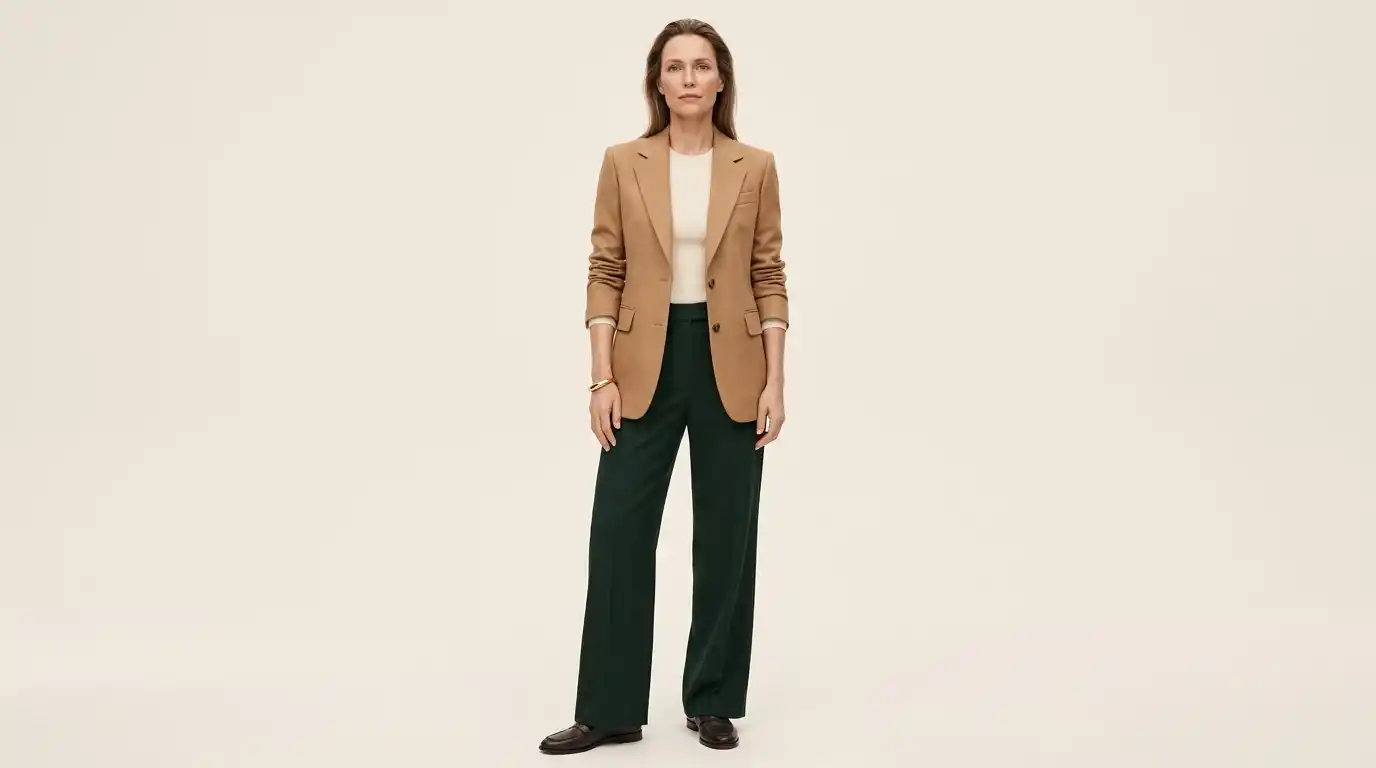
You do not need to build all seven of these. Pick two, try them this week, and see what actually works for your body and your office.
- Blazer + wide leg trouser + loafer + one metallic accessory (a belt or a shoe). Clean, simple, and instantly reads as put together.
- Knit dress + longline coat + clean leather loafer. This is the desk day formula: comfortable enough to sit in all day, put together enough for a surprise meeting.
- Collarless blazer + fitted tank or tee + structured trouser. A quiet, confident look that skips the stiffness of a traditional suit.
- Matching set (soft blazer and trouser, bought as a pair) + simple pump or loafer. One decision, zero effort, still looks intentional.
- Dark, structured denim + blazer + silk blend blouse + loafer. This is your smart casual office formula, for days when full business wear feels like too much.
- Military style jacket + simple knit + straight trouser. This jacket brings its own structure to the outfit, so everything else can stay simple.
- High quality leggings or joggers + structured jacket + sleek sneaker. Save this for hybrid days or offices with no real dress code. It still reads as intentional, not like you rolled out of bed.
Notice what all seven have in common: one structured piece doing the heavy lifting, and everything else staying simple around it. That is the whole formula, in every outfit you will ever build.
How to Dress Through Body Changes Without Losing Polish
Your body changes in this decade. Temperature regulation shifts. Waistbands that felt fine last year might not this year. None of that means you have to dress around discomfort just to look put together at work.
A few practical fixes:
- Choose breathable, layerable fabrics so you can add or remove a layer as your temperature shifts through the day.
- Look for trousers with a small amount of stretch built in, so you stay comfortable through back to back meetings.
- Skip heavy, heat trapping fabrics if you deal with hot flashes. Cotton blends and lightweight knits breathe better than synthetic blends.
Here is the bigger point, though. A lot of old advice tells women over 40 to cover their arms, avoid bright colors, or stick to loose, shapeless pieces “to be safe.” Current style writers in this space push back on that hard.
There is no rule that says fitted clothing, color, or bare arms are off limits after a certain age. The actual guidance is about fit and comfort, not about hiding.
Dress for how your body feels today, not for a rule someone else made up decades ago. Comfort and polish are not opposites. You can have both.
Where to Spend and Where to Save on Work Clothes
You do not need an unlimited budget to build a work wardrobe that works. You need to know where to spend and where to save.
| Budget Level | Brands to Check | Best For |
|---|---|---|
| Entry level | H&M, Primark, Matalan, resale sites like Vinted | Trend pieces you are testing, not committing to |
| Mid range | Boden, Marks and Spencer, John Lewis, River Island, Talbots, Ann Taylor, J.Crew | Reliable pieces you will wear weekly |
| Invest | Reiss, Vince, Banana Republic, Mango, Eileen Fisher | The 2 or 3 pieces you wear every single week: your main blazer, your coat, your go to trousers |
Some of these brands are UK based and some are US based. Check what is available and reasonably priced where you live before you build your list.
Here is the simple rule: spend on what touches your body all day and shows up in every meeting.
That means your blazer, your trousers, your coat, your shoes. Save on anything you are trying for one season, like this year’s specific color or print.
You do not need to spend big everywhere. You need to spend well on the handful of pieces doing most of the work.
The Bottom Line
Dress codes changed. Your closet does not have to chase that change piece by piece. Build a small, sharp capsule wardrobe, know what your actual office expects, and get the two or three pieces you wear every week properly fitted.
Start with one thing this week. Either run the 3-3-3 audit on your current closet, or take one piece in to get altered.
That is a smaller commitment than a whole new wardrobe, and it is the fastest way to feel like yourself again at work.
That is the real answer to what to wear to work over 40: fewer pieces, better fit, and a wardrobe built for the office you actually have.