
How to Style a Trench Coat Over 40 With Clothes You Already Own


To style a trench coat over 40, start with fit: shoulder seams on the natural shoulder line, sleeves ending at the wrist bone, and a hem near the knee. Layer thin, fitted pieces underneath in one color, then use the belt to shape the waist. Skip chunky knits under the coat, because the bulk fights its straight lines.
You loved the trench in the store. At home, figuring out how to style a trench coat over 40 became a different problem, because now it looks square, the belt dangles, and the coat seems to be wearing you.
Most of the time the coat is fine. A trench is built with structure: shoulders, lapels, a belt. When the layers underneath stay thin and the colors stay simple, that structure works in your favor.
By the end, you will have 2 outfits you can repeat, one for work and one for weekends, built from what is already in your closet. Plan on about 20 minutes in front of a mirror the first time. After that, getting dressed takes 2.
Style The Trench
A Modern Guide For Over 40
Strict on the Fit
Ensure the coat flatters your natural shape. Check that shoulder seams align with your shoulder bone, and sleeves end exactly at the wrist bone to avoid a boxy look.
Thin, Monochromatic Layers
Build a single-color base from neck to shoe using thin, fitted pieces (like silk blouses or fine knits). Skip chunky sweaters that fight the coat’s structured lines.
Master the Belt Knot
Never let the belt dangle. Tie it behind you when wearing the coat open to create a waist, or knot it slightly off center when buttoned up for a relaxed, neat finish.
Add One Strong Accent
The coat already brings structure. Add only one accent piece to avoid visual clutter—choose a colorful silk scarf near the face, gold hoops, or a structured bag.
What You Need
- 1 trench coat (classic belted style, any neutral color)
- 1 full-length mirror
- 2 or 3 thin fitted tops: a tee, a fine-knit sweater, or a silk blouse
- 1 pair of straight or wide-leg pants, or 1 midi dress
- 2 pairs of shoes, one flat and one dressier
- 1 silk scarf (optional)
- 1 soft measuring tape (optional)
How Long It Takes and What It Costs
Styling uses what is in your closet, so the only real cost is the coat itself if you still need one.
| Total time | About 20 minutes |
| Hands-on time | About 20 minutes |
| Cost | $0 with a coat you own |
| New mid-range trench | About $80 to $300 |
| Difficulty | Beginner |
Coat prices vary a lot by store, fabric, and season. Check the sale section before paying full price.
Steps at a Glance
Here is the whole process on one screen.
- Check the shoulder seams in a mirror.
- Measure where the sleeves stop.
- Pick a hem length for your height.
- Choose thin layers for underneath.
- Build a one-color base outfit.
- Decide whether to wear it open or closed.
- Tie the belt behind you when the coat is open.
- Knot the belt slightly off center when it is closed.
- Push the sleeves up to show your wrists.
- Match your shoes to where you are going.
- Add one accent, and stop there.
Check the shoulder seams in a mirror
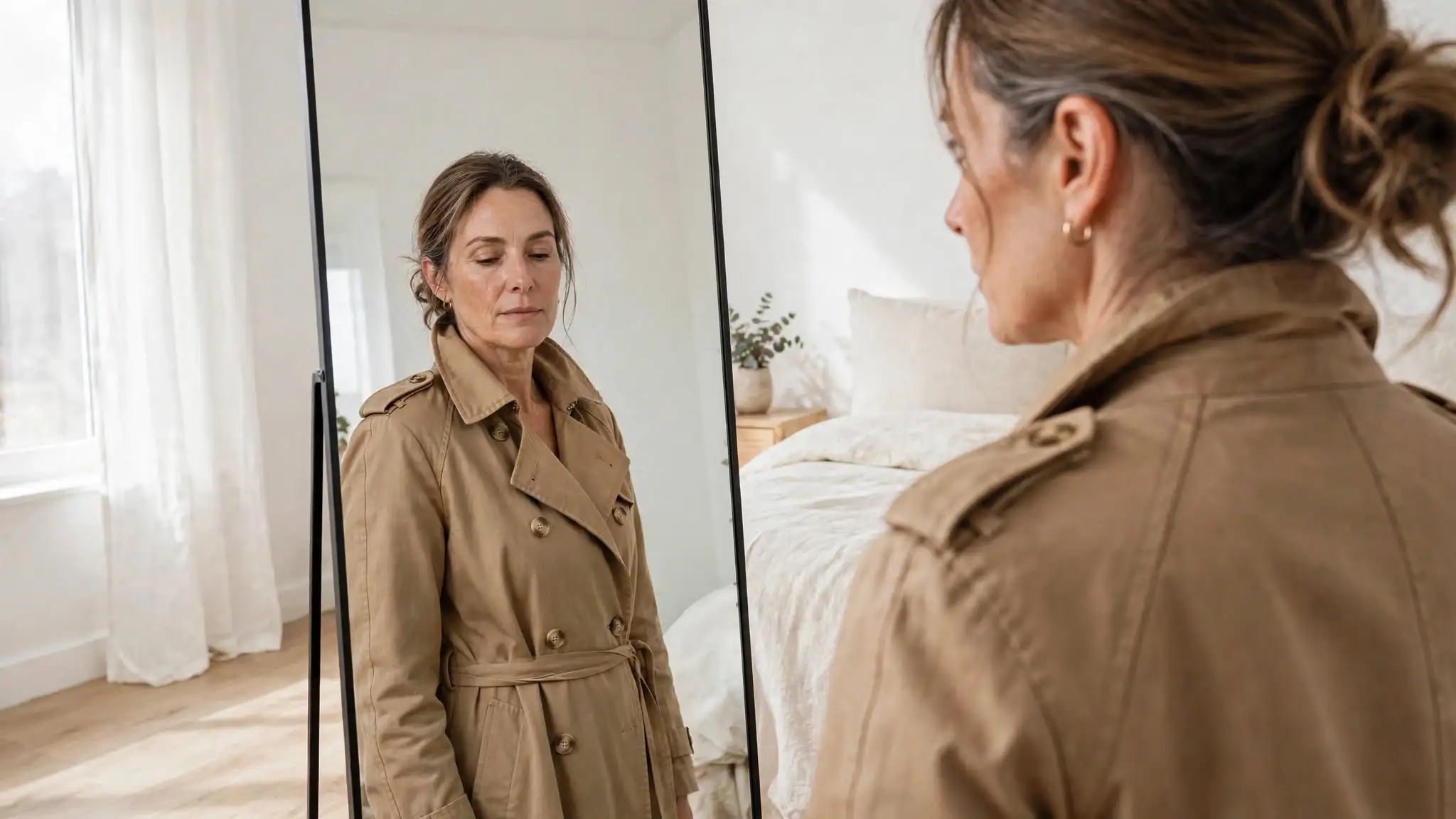
Put the coat on over a thin top and button it. The seam where the sleeve joins the body should sit at the outer edge of your shoulder bone.
A small drop is fine on a relaxed cut. Seams that slide down toward your upper arm are what make a trench look boxy.
Shoulders are the hardest part of a coat for a tailor to change. This is the one fit point worth being strict about, whether you own the coat already or are still shopping.
Measure where the sleeves stop

Sleeve length is the detail that makes a coat look like it was made for you. Let your arms hang straight at your sides.
The cuff should end at your wrist bone, the knob on the outside of your wrist. You will know it is right when your watch or bracelet shows without pushing anything up.
Pick a hem length for your height

If you are under about 5 feet 4 inches (163 cm), a hem at the knee or a little above keeps the coat from swallowing you. Taller frames can carry anything from the knee to mid-calf.
With a dress or skirt, keep the two hems clearly apart. I aim for at least 2 inches (5 cm) of difference either way, because hems that almost line up look like a mistake.
Petite and already own a long trench? Keep it. Wear it open over one color, which Step 5 covers.
Choose thin layers for underneath
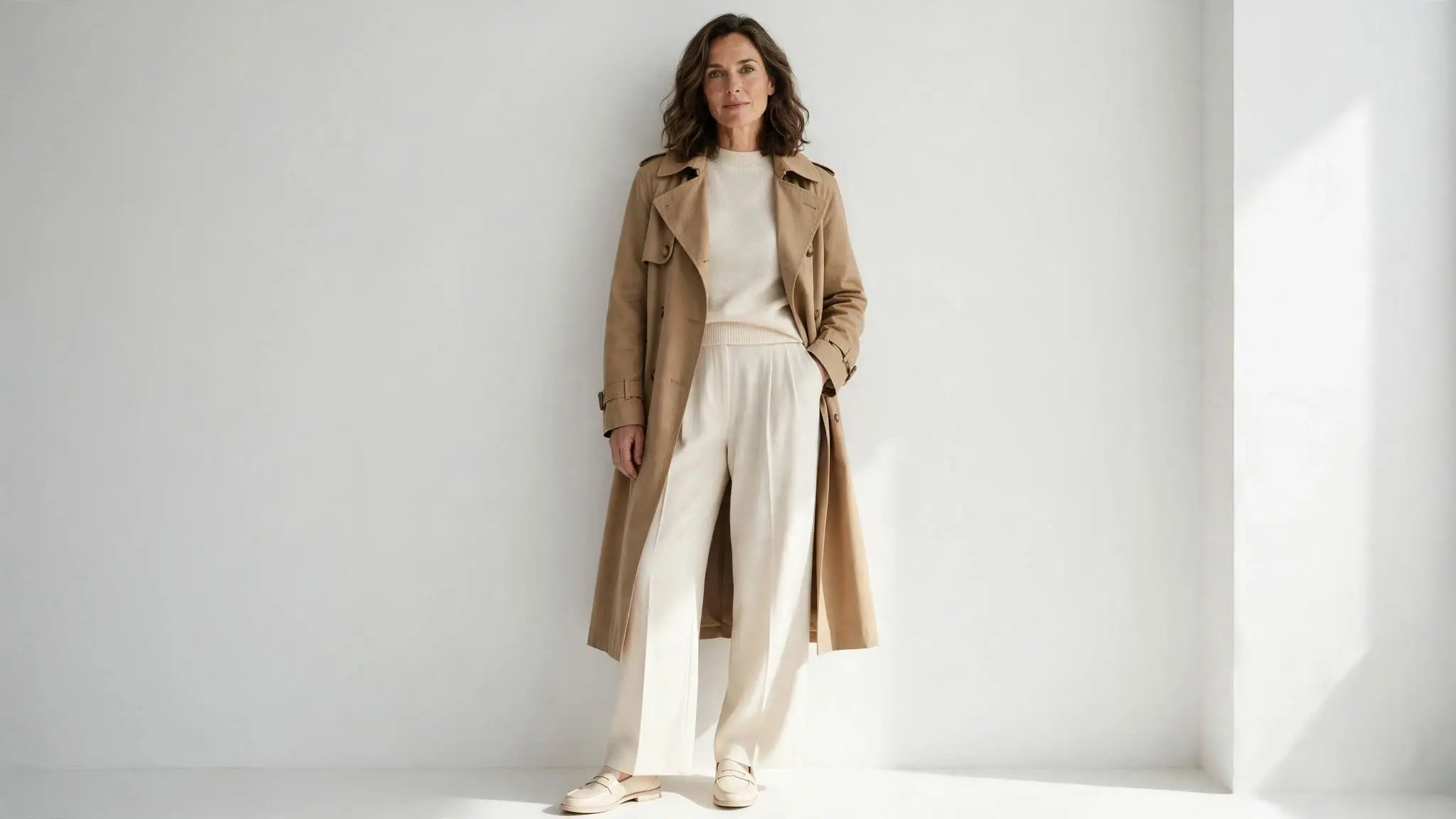
The coat is cut to sit close to the body, so what goes under it decides whether it drapes or strains. These layers work well:
- A fitted cotton tee or long-sleeve tee
- A fine-knit sweater in merino or cashmere
- A silk or silky blouse
- A button-down shirt, tucked in
Build a one-color base to style a trench coat over 40
A single color from neck to shoe makes a long, unbroken line down the middle of an open coat. That line does more for your shape than any belt trick.
Black, navy, cream, and gray all work. So does head-to-toe denim in similar washes. Pick the shade you already own the most pieces in.
The colors do not need to match exactly. Close shades, like camel with cream or charcoal with black, read as one color from a few feet away.
Decide whether to wear it open or closed

On a windy or wet day, the answer is made for you: button it and belt it.
In mild weather, open looks relaxed and shows off the outfit underneath. Closed looks sharper and more formal, which suits the office. Choose before you touch the belt, because the way you tie it depends on this.
Tie the belt behind you when the coat is open
A loose belt hanging from the loops drags through every car door and puddle. Tying it in back keeps it off the ground and gives the open coat a waist.
Pull both belt ends around to your back and cross them at the small of your back. Tie a square knot and draw it snug, so the back of the coat gathers slightly. Let the tails hang.
Knot the belt slightly off center when it is closed
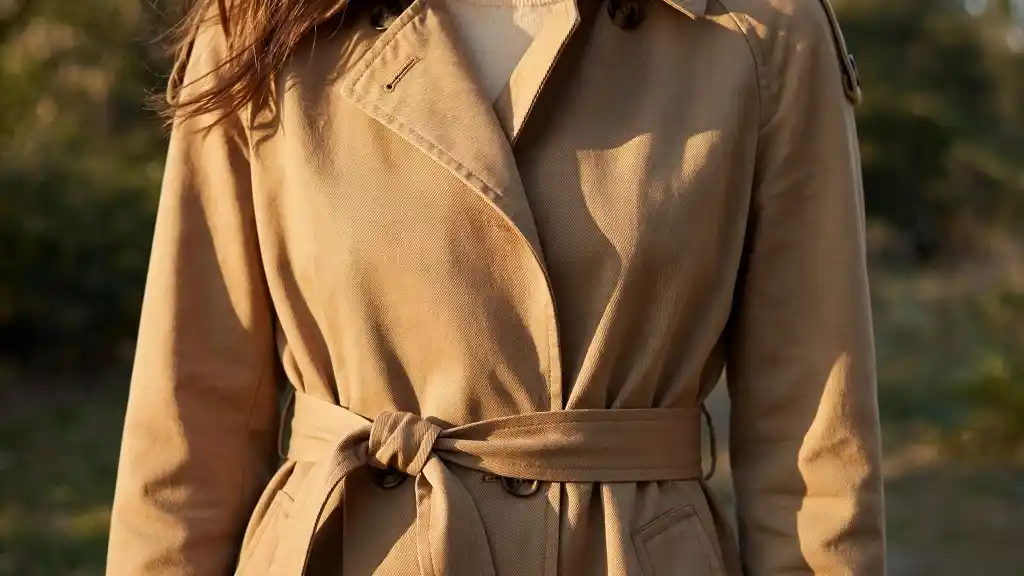
Set the knot a little to one side of your belly button. Dead center looks stiff, while slightly off center looks relaxed and still neat.
Cross the long end over the short end, tuck it under, and pull. Cross again in the opposite direction and pull both ends. That reversed second cross is what makes a square knot lie flat instead of twisting sideways.
Stiff cotton gabardine holds a knot all day. Silky, drapey trenches slip, so double the knot or use the buckle and tuck the tail into the small keeper loop.
Push the sleeves up to show your wrists
A few inches of bare wrist breaks up all that fabric and makes the coat look lived in. Push each sleeve up about 2 to 3 inches (5 to 8 cm).
Stiff sleeves stay where you put them. Soft ones slide back down, so fold the cuff back twice instead.
For weekends, pop the collar at the same time. For work, leave both the collar and cuffs down.
Match your shoes to where you are going
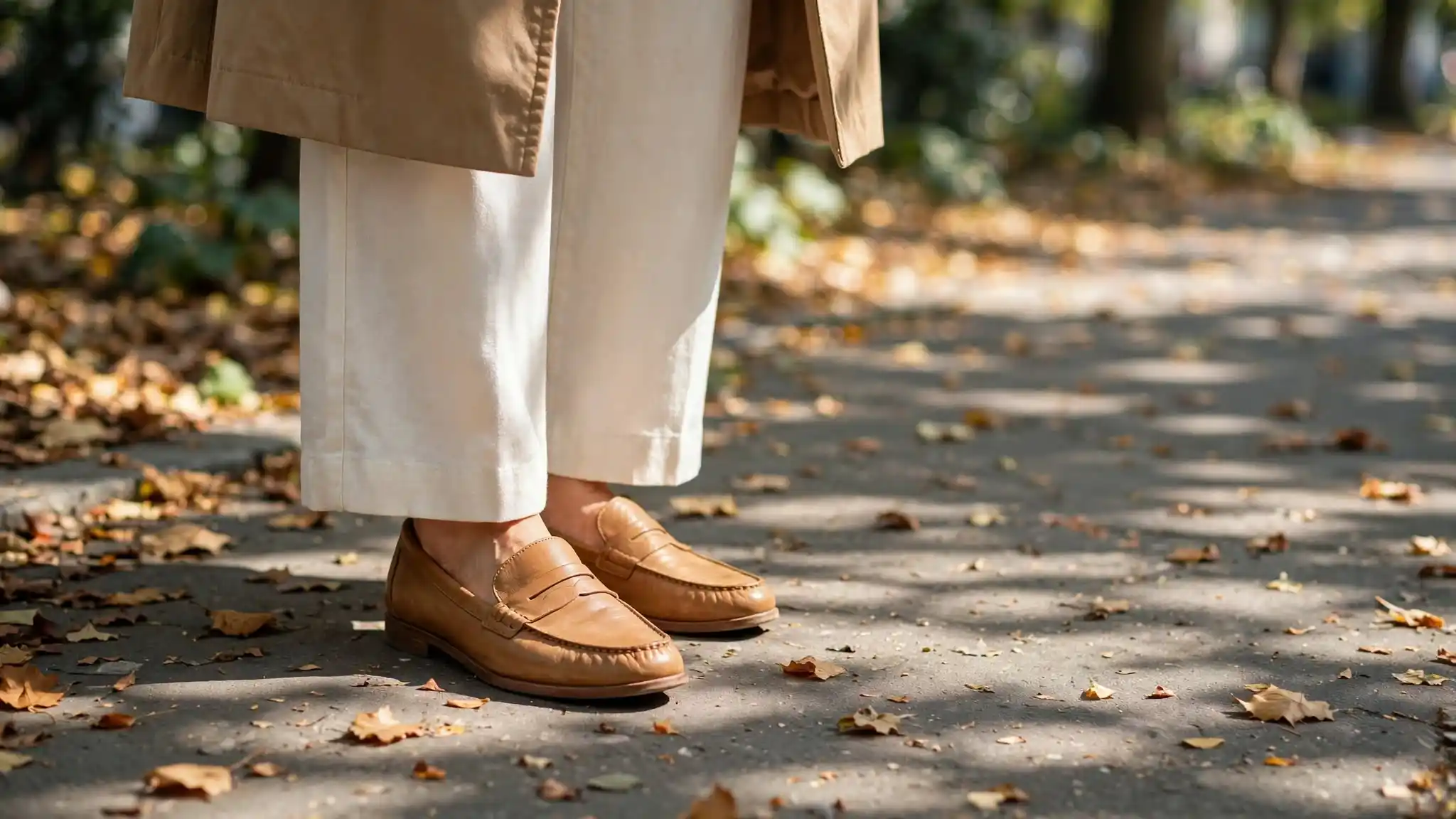
For weekends and long walks, white leather sneakers or flat loafers keep the look casual and let you move all day.
For work, a low block heel, a kitten heel, or a sleek ankle boot matches the coat’s tailored lines. With wide-leg pants, pick a shoe with a pointed toe that peeks past the hem, so the pants do not puddle on the floor.
Try both pairs with the coat on in the mirror. The right one usually looks obvious within seconds.
Add one accent, and stop there
One accent gives the eye a place to land. A trench already has buttons, a belt, and shoulder tabs, so two or three extras start competing with it.
Good single accents are a silk scarf, a structured bag in a color, or a pair of gold hoops. Choose one per outfit.
Troubleshooting
Most trench problems come down to one of these.
| If this happens | Try this |
|---|---|
| Coat looks boxy and square | Belt it, then recheck the shoulder seams |
| Belt keeps sliding loose | Double the knot or use the buckle |
| Sleeves cover your hands | Fold cuffs back twice, or see a tailor |
| Coat swallows a petite frame | Wear it open over one color |
| Dress hem peeks out oddly | Keep 2 inches of hem difference |
| Buttons pull across the chest | Switch to a thinner layer |
| Rain soaks through the fabric | Re-treat with water repellent spray per the label |
What to Do Instead If the Belt Drives You Crazy
Some people never make peace with the belt, and that is fine. A trench worn open with no belt looks clean over a one-color outfit.
Slide the belt out of its loops and store it in a pocket or drawer so it does not get lost. You can thread it back in any day you want a defined waist.
Final Thoughts
Learning how to style a trench coat over 40 comes down to fit first, then thin layers and one color underneath.
The belt knots feel awkward for about a week. After that, your hands do them without thinking.
Start with the outfit you would wear tomorrow, and fix one thing at a time.
Save this pin to your fall outfits board so the belt knots and fit checks are there the next time you reach for your trench.
Frequently Asked Questions
What trench coat color is most flattering after 40?
No single color flatters everyone. Classic beige and camel work for many skin tones, but if beige makes you look tired, navy, black, or olive are safe swaps. A scarf in a color you love near your face also helps.
Should my trench be longer or shorter than my dress?
Either works. Keep the hems at least 2 inches (5 cm) apart so the look reads as intentional.
Can petite women wear a long trench coat?
Yes. Wear it open over a single color to keep a long vertical line, and look for a hem that hits no lower than mid-calf.
Is it OK to wear a trench coat without the belt?
Yes. An unbelted, open trench looks relaxed and modern, especially with sneakers or loafers.
Is a trench coat waterproof?
Most cotton gabardine trenches are water resistant, not fully waterproof. They handle drizzle and light rain well, and the water resistance can fade with wear and washing.
Can I wear a trench coat in winter?
A classic cotton trench is a light coat. In mild winters, layer a fine-knit sweater and scarf under it. For real cold, look for a wool trench or one with a zip-out lining.